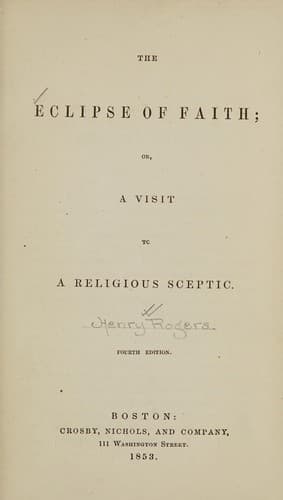
The Eclipse of Faith; Or, A Visit to a Religious ScepticRogers, Henry
Religion
The Eclipse of Faith; Or, A Visit to a Religious Sceptic
Rogers, Henry
Skepticism -- Controversial literature
July 30. I was much interested yesterday morning by a conversation
between Harrington and two pleasant youths, acquaintances of Mr.
Fellowes, both younger by three or four years than either he or
Harrington. They are now at college, and have imbibed in different
degrees that curious theory which, professedly recognizing
Christianity (as consigned to the New Testament) as a truly
divine revelation, yet asserts that it is intermingled with a large
amount of error and absurdity, and tells each man to eliminate
the divine element for himself. According to this theory, the
problem of eliciting revealed truth may be said to be indeterminate;
of the unknown x varies through all degrees of magnitude; it is equal
to any thing, equal to every thing, equal to nothing, equal
to infinity.
The whole party thought, with the exception of Harrington, who knew
not what to think, that the "religious faculty or faculties" (one or
many,--no man seems to know exactly) are quite sufficient to decide
all doubts and difficulties in religious matters.
Harrington knew not whether to say there was any truth in Christianity
or not; Fellowes knew that there was none, except in that "religious
element," Which is found alike essentially in all religions; that
its miracles, its inspiration, its peculiar doctrines, are totally false.
The young gentlemen just referred to believed "that it might be admitted
that an external revelation was possible," and "that the condition of
man, considering the aspects of his history, has not been altogether
felicitous as to show that he never needed, and might not be benefited,
by such light." I could cordially agree with them so far; superabundance
of religious illumination not being amongst the things of which humanity
can legitimately complain.
But then, as they both believed that each man was to distil the "elixir
Vitrae" for himself from the crude mass of truth and falsehood which
the New Testament presents, Harrington, with his interrogations, soon
compelled them to see how inconsistent they were both with themselves
and with one another. One of them believed, he said, that the Apostles
might have been favored by a true revelation; but not in such a sense
"as to prevent their often falling into serious errors," whenever the
distinctly "religious element" was not concerned; this was the only
truly "divine" thing about it; but he saw no particular objection to
receiving the miracles; at least some of them,--the best authenticated
and most reasonable; perhaps they were of value as part of the complex
evidence needful to establish doctrines which, if not absolutely
transcendental to the human faculties,--as the doctrine of a future life,
for example,--yet, apart from revelation, are but matter of conjecture.
Public-domain text, read in full here on John Shaqi.
Reviews
Reviews
No reviews yet
Be the first to share your thoughts on this work.
Elsewhere in the archive
Join the Discussion
Join the discussion
Sign in to leave a comment or review.
Sign InorCreate an account