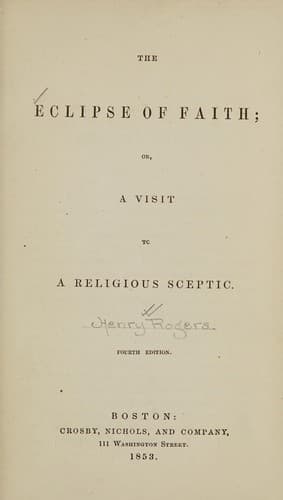
The Eclipse of Faith; Or, A Visit to a Religious ScepticRogers, Henry
Religion
The Eclipse of Faith; Or, A Visit to a Religious Sceptic
Rogers, Henry
Skepticism -- Controversial literature
"But there were some persecutions," you will say, "by Constantine."
True, but they were so trifling compared with what would have been
required had the conversion of an unbelieving and refractory empire
depended on such means, that few who read the history of religious
revolutions will believe that they were the cause of the change. Every
thing shows that a vast preceding moral revolution in the empire is
the only sufficient explanation of so sudden an event. Gibbon himself
admits Constantine's tolerant disposition.
"But," it may be said, "the old heathenism was worn out and effete;
no one thought it worth his while to stand up in its defence."
I answer, first, it seems to have been sufficiently loved, or at
least Christianity was sufficiently hated, to insure frequent and
sanguinary persecutions of the latter, almost up to the eve of
Constantine's accession. Secondly, you are to consider that, though
in the schools of philosophers, in the Epicurean or sceptical
atmosphere of the luxurious capital and other great cities, there was
unquestionably a numerous party to whom the old superstition was a
laughing-stock, there were vast multitudes to whom it was still, in
its various forms, a thing of power. You are to recollect that the
Roman empire was made up of many nations, each with a different mode
of religion, and to suppose that these different religions had ceased
to exercise the usual influence on vast multitudes of the people would
be mere delusion. If they were surrendered at last so easily, it could
only be because a great party--antagonistic to each--had been silently
forming in each nation, and undermining the power of the popular
superstitions. But, thirdly, if the representation were true, to
what can so singular a phenomenon--this simultaneous decay of different
religions, this epidemic pestilence amongst the gods of the Pantheon
--be ascribed, but to the previous influence of Christianity, and its
extensive conquests? And, fourthly, supposing this not the case, and
yet that the indifference in question existed, this indifference to
the old systems of religion would not presuppose equal indifference
to new, or induce the people to embrace them at the mere bidding of
their new master. If this were so, we ought to see the same phenomenon
repeated in the case of Julian. If, in their presumed indifference to
the old and the new, they listened to Constantine when he commanded
them to become Christians, why did not they manifest an equally
compliant temper when the Apostate enjoined them to become heathens,
and like Constantine, gave them both precept and example?
Public-domain text, read in full here on John Shaqi.
Reviews
Reviews
No reviews yet
Be the first to share your thoughts on this work.
Elsewhere in the archive
Join the Discussion
Join the discussion
Sign in to leave a comment or review.
Sign InorCreate an account