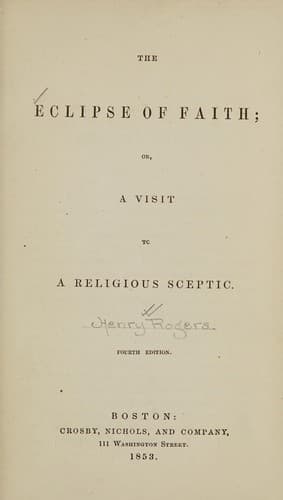
The Eclipse of Faith; Or, A Visit to a Religious ScepticRogers, Henry
Religion
The Eclipse of Faith; Or, A Visit to a Religious Sceptic
Rogers, Henry
Skepticism -- Controversial literature
But look at the historic evidence on the subject long before the
establishment of Christianity. Is it possible for any candid person to
read the Epistle of Pliny to Trajan, and not see in that alone, after
making every deduction for any supposed bias under which the letter may
have been written (though, in fact, it is difficult to suppose any
bias that would not rather lead the writer to diminish the number of
the Christians than to exaggerate it),--is it possible, I say, to read
that singular state paper, and not feel that the new religion had
made prodigious progress in that remote province? and that, a fortiori,
if in Bithynia it had conquered its thousands of proselytes, in other
and more favored provinces it must have gained its tens of thousands?
To me the letter of Pliny speaks volumes; and if so much could be said
at so early a period as A. D. 107, what was the state of things two
centuries later?
Precisely the same conclusion must be arrived at if we consult the
uniform tone of the Christian apologists, from Justin Martyr to Minucius
Felix. Making here, again, what deductions you please for the fervid
eloquence and rhetorical exaggerations of such a man as Tertullian, it
is too much to suppose even his "African" impetuosity would have
ventured, not merely on the virulent invective, the bold taunts, with
which he everywhere assails the popular superstitions, but on such
strong assertions of the triumphant progress of the upstart religion,
unless there had been obvious approximation to truth in his statements.
"We were but of yesterday," says he, "and we have filled your cities,
islands, towns, and assemblies; the camp, the senate, the palace, and
the forum swarm with converts to Christianity." Apologist for
Christianity! Unless these words had been enforced by very much of
truth, he would have made Christianity simply ridiculous; and
Christians would have been necessitated to apologize for
their mad apologist.
The same conclusion equally follows from the consideration of those
very corruptions of Christianity, which no candid student of
ecclesiastical history will be slow to admit had already infected
it, many years before Constantine ventured to aid it by his equivocal
patronage. It was obviously its triumphant progress,--its attraction
to itself of much wealth,--the accession, to a considerable extent,
of fashion, rank, and power,--that chiefly caused those corruptions.
So long as the Christian Church was poor and despised, such scenes
as often attended the election of bishops in the great cities of the
empire would be quite impossible.
Public-domain text, read in full here on John Shaqi.
Reviews
Reviews
No reviews yet
Be the first to share your thoughts on this work.
Elsewhere in the archive
Join the Discussion
Join the discussion
Sign in to leave a comment or review.
Sign InorCreate an account