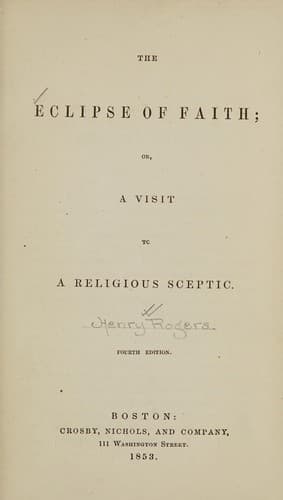
The Eclipse of Faith; Or, A Visit to a Religious ScepticRogers, Henry
Religion
The Eclipse of Faith; Or, A Visit to a Religious Sceptic
Rogers, Henry
Skepticism -- Controversial literature
Under such circumstances the argument of Mr. Newman--judiciously
compressed into a few sentences--appears to me even ludicrous. How
different the course which Gibbon pursues! What a pity that the
great historian did not perceive that this statement would have led
him equally well to his desired end; that so brief a demonstration
would suffice to account for that unmanageable phenomenon, the rapid
progress and ultimate triumph of Christianity! He, on the contrary,
seems to have read history with very different eyes; and yet I suppose
no man will question either his learning or his sagacity. He finds
himself obliged to admit the conspicuous advance which the Gospel had
made before Constantine's accession, and employs every nerve to invent
sufficient natural causes to account for it. What a facile task would
he have had of it, if he had but bethought him that Christianity,
instead of having been to an enormous extent successful was, in
fact, waiting, in comparative failure, the triumphant aid of a
military conqueror! He might then have dispensed with the celebrated
chapter, and substituted for it the two pregnant sentences by which
Mr. Newmen has, in effect, declared it superfluous.
____
August 7. Three days ago (the evening before my return home) I managed
to prevail upon myself to have a close and formal discussion with
Harrington on the subject of his scepticism. We had a regular fight,
which lasted till midnight, and beyond. A good deal of it was (in a
double sense, perhaps) a nuktomachia. As I had no one to jot down
short-hand notes of our controversy,--perhaps it is as well for me and
for truth that there was none,--it is impossible that I should do more
than give you a succinct summary of its course. But its principal
topics are too indelibly impressed on my memory to leave me in doubt
about general accuracy.
I hardly know what led to it; I believe, however, it was an observation
he made on the different fates of metaphysical and physical science,--the
last all progress, and the first perpetual uncertainty. He had been
reading a remark of some philosopher who attributed this difference to
the more substantial incentives offered to the cultivation of the
physical sciences. "So that," said he, "they are, it seems, what our
German friends would call 'Brodwissenschaften'! Not the brain, as some
idly suppose, but the stomach, is the true organon of discovery, and
if the metaphysician could but be punctually assured of his dinner
(which has not always been the case), or at all events of a fortune,
we should soon have the true theories of the Sublime and
Beautiful,--of Ethics,--of the Infinite,--of the Absolute,--of Mind
and Matter,--of Liberty and Necessity; whereas I think we should
only have a multiplication of doubtful theories."
Public-domain text, read in full here on John Shaqi.
Reviews
Reviews
No reviews yet
Be the first to share your thoughts on this work.
Elsewhere in the archive
Join the Discussion
Join the discussion
Sign in to leave a comment or review.
Sign InorCreate an account