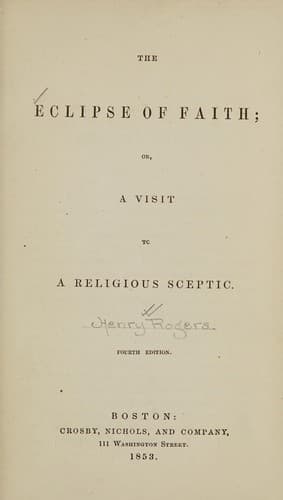
The Eclipse of Faith; Or, A Visit to a Religious ScepticRogers, Henry
Religion
The Eclipse of Faith; Or, A Visit to a Religious Sceptic
Rogers, Henry
Skepticism -- Controversial literature
I admitted, of course, that the will had no direct power in the matter;
but reminded him that, if he meant it had no influence, or even a little,
on the formation or retention of opinions, no one could be a more
strenuous assertor of the contrary than he had often been. I reminded
him it was so notorious that man usually managed to believe as he wished,
that was no one maxim more frequently on the lips of the greatest
philosophers, orators, and poets. But I added that there is also a
legitimate way of influencing will, and that is through the understanding;
and was with the hope of inducing him to reconsider the paradoxes of
scepticism, and not with any expectation of instant or violent change,
that I was anxious to enumerate them on the present occasion.
It is impossible for me to recollect exactly the course
of the long conversation that ensued; suffice it to say, that he
willingly granted many other paradoxes, some of them so readily, as
to confirm the suspicion I had sometimes felt, that he must often
have doubted the validity of his doubts. He admitted, for example,
that since men in general (whether from the possession of a distinct
religious faculty, though it might be corrupt and depraved, or a
mere rudimentary tendency to religion) had adapted some religion,
religious scepticism, in an intelligible sense, was opposed to nature;
--that it was equally opposed to nature, inasmuch as the general
constitution of man sought and loved certainty, or supposed certainty,
and found a state of perpetual doubt intolerable; and that if this be
attributed to a tendency to dogmatism, that is the very tendency of
nature which is affirmed;--that it is opposed to nature again in this
way, that whereas restlessness and agitation of mind are usually, at
all events, warnings to seek relief, scepticism produces these as its
pure and proper result;--that since, by the confession of every mind
worthy of respect, the great doctrines of religion, if not true, are
such that we cannot but wish they were; since, by his own confession,
scepticism has nothing to allure in it, and rather causes misery than
happiness; and since, by his confession and that of every one else, men
in general easily believe as they wish, it is an unaccountable paradox,
that any one should remain a sceptic for a day, except, indeed, from a
guilty fear of the truth;--that, since scepticism tends to misery, it
is better not to know its truth, and that therefore ignorance is better
than knowledge;--that, if Christianity be an illusion, it, at all events,
tends to make men happier than the truth of scepticism, and that therefore
error is better than truth;--that religious scepticism is open to the
same objection as scepticism absolute; for whereas the last is taunted
with trusting to reason to prove that reason can in nothing be trusted,
religious scepticism is chargeable with declaring the certainty of all
uncertainty, and, while proclaiming: that there is nothing true, avowing
Public-domain text, read in full here on John Shaqi.
Reviews
Reviews
No reviews yet
Be the first to share your thoughts on this work.
Elsewhere in the archive
Join the Discussion
Join the discussion
Sign in to leave a comment or review.
Sign InorCreate an account