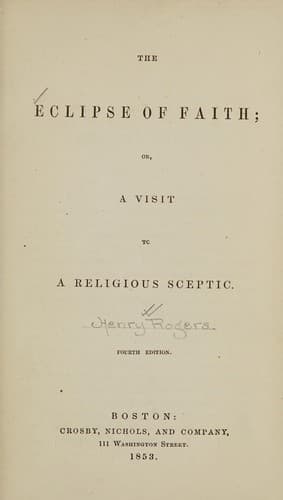
The Eclipse of Faith; Or, A Visit to a Religious ScepticRogers, Henry
Religion
The Eclipse of Faith; Or, A Visit to a Religious Sceptic
Rogers, Henry
Skepticism -- Controversial literature
that that is truth and lastly, that if, in consistency, it leaves
even that uncertainty uncertain, it arrives at a conclusion which
everlastingly remits us to renewed investigation!
"But," said he, "the sceptic does affirm the certainty of all
uncertainty. That is precisely my state of mind, even in relation
to Christianity. Both its truth and falsehood are--uncertain."
"Then," said I, "I must not say you reject Christianity, but only
that you do not receive it?
"Precisely so," said he, with a smile and a blush at the same time.
I was much amused with this logical ceremoniousness, by which a man
is not to say that he rejects any thing so conditioned, but only
that he does not receive it. I told him I imagined they came to
much the same thing.
"It is impossible," said he, after a pause, "to affirm any thing on
these subjects."
"It is equally impossible?" said I, "to affirm nothing; on the
contrary, you sceptics have two conclusions, though in a negative
form, for every body else's one,--together with the pleasant addition,
that they are contraries to one another; and as Pascal said that the
man who attempted to be neuter between the sceptic and dogmatist was
a sceptic par excellence, so the genuine sceptic may be called a
dogmatist par excellence."
"For my part," said he, smiling sadly, "I hardly think it is very
difficult either to believe nothing or every thing. Fellowes, you see,
has believed everything, and now he is in a fair way to believe nothing.
However, all I mean is, that the evidence on these subjects reduces
one to a state of complete mental suspense, in which it is equally
unreasonable to say that we believe, as to say that we believe not.
However, I grant you most of the paradoxes you mention; but a sceptic
is not to be startled by paradoxes, I trow; alas! they prove nothing."
"Prove nothing! nay, I think you do your system injustice; I think it
is entitled to the distinction of making great discoveries. You confess
that the only truth on these subjects is, that there is no truth; that
to act on this truth necessitates a conduct opposed to nature, to
prudence, to happiness; that it is a knowledge worse than ignorance;
that it is a truth that is worse than error; that it never did, will,
or can be embraced by many, and that it makes the few who embrace it
miserable; you admit further, with me, that men generally believe as
they wish. Why, then, do you not fly from so hideous a monster, on
the very ground (only in this case it is stronger) on which you doubt
all religious systems,--that is, on account of the supposed paradoxes
they involve? It may be but a little argument with you, who seem to
demand demonstration of religious truth; but for myself, I feel that,
whatever be the truth, such a chimera as scepticism, bristling all
over with paradoxes, must be--a lie."
"Well," he replied, "but then which religion is the true?"
Public-domain text, read in full here on John Shaqi.
Reviews
Reviews
No reviews yet
Be the first to share your thoughts on this work.
Elsewhere in the archive