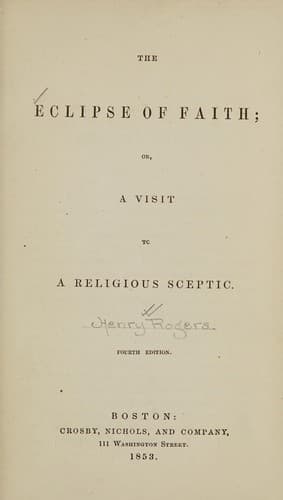
The Eclipse of Faith; Or, A Visit to a Religious ScepticRogers, Henry
Religion
The Eclipse of Faith; Or, A Visit to a Religious Sceptic
Rogers, Henry
Skepticism -- Controversial literature
It was a painful question; but I was resolved I would have nothing
to reproach myself with; and therefore answered steadily, that it was
not for me to judge the degree of blame which attached to his present
state of mind, which I trusted was only transient; that the argument
from sincerity was itself only one of the probable things of which we
had been speaking; that, so subtle are the operations of the human mind,
so mysterious the play of the passions and affections, the reason and
conscience, so intimate the connection amongst all our powers and
faculties, that it is one of the most difficult things to be able to
say, with truth, that we are perfectly sincere; that I did not see
any difficulty in believing that there is many a man who, without
hesitation and without any conscious hypocrisy, would avow his
sincerity, who, upon being suffered to look into his own mind through
a moral solar microscope, would see there all sorts of misshapen
monsters, and turn away from the spectacle with disgust and horror;
that such a microscope (to speak in figure) might one day be applied
by that Power to whom only the human heart is fully known. I added,
however, that, if I knew more of his mental history for some years
past, (into which my affection-should never induce me impertinently
to pry,) I might, perhaps, in some measure, account for his scepticism;
that I could even conceive cases of minds so "encompassed with
infirmity," or so dependent on states of health, as to render such a
state involuntary, and therefore to take them out of the sphere of
our argument. But, apart from some such causes, I plainly told him I
could not permit myself to believe that religious scepticism could be
free from heavy blame, if only on the ground that such as feel it do
not act consistently with its maxims in other cases, where the
evidence is of the same dubious nature, or rather is much more dubious.
The parallel case would be, (if we could find it,) of a man whose
interest urgently required him to act one way or the other, and who,
instead of acting accordingly, sat down in absolute inaction, on the
score that he did not know what course to pursue. That indecision
would be always blamable. "Ah!" said I, "those cool heads and skilful
hands which pilot the little bark of their worldly fortunes amidst
such dangerous rocks and breakers, under such dark and stormy skies,
what can they say, if asked why they gave up all thought of religion
on the score of doubt, when its hopes are at least as high as those of
the schemes of earthly success, and its claims at least as strong as
those of present duty? What will they be able to say?
Public-domain text, read in full here on John Shaqi.
Reviews
Reviews
No reviews yet
Be the first to share your thoughts on this work.
Elsewhere in the archive
Join the Discussion
Join the discussion
Sign in to leave a comment or review.
Sign InorCreate an account