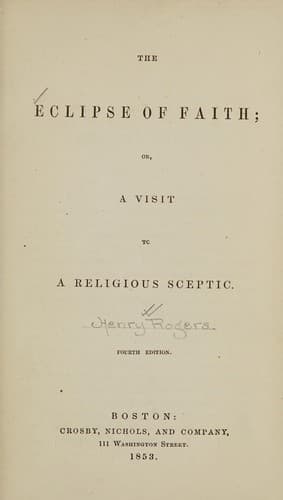
The Eclipse of Faith; Or, A Visit to a Religious ScepticRogers, Henry
Religion
The Eclipse of Faith; Or, A Visit to a Religious Sceptic
Rogers, Henry
Skepticism -- Controversial literature
to play our part; if we stand shivering on the brink of action,
necessity plunges us headlong in; if we fear to hoist the sail, the
strength of the current of life snaps our moorings, and compels us to
drive. I reminded him, that the general result also shows that, as man
must, so he may, can, will, shall, (and so through all the moods and
tenses of contingency,) do well; that faith in that same sort of evidence
which the sceptic rejects when urged in behalf of religion, prompts the
farmer to cast in his seed, though he can command no blink of sunshine,
nor a drop of rain; the merchant to commit his treasures to the deep,
though they may all go to the bottom, and sometimes do; the physician
to essay the cure of his patient, though often half in doubt whether
his remedy will kill or save. "It is," said I, "in that same faith
that we build, and plant, and lay our little plans each day; sometimes
coming to nothing, but generally, and according to the fidelity and
manliness with which we have conducted ourselves, securing more than
a return for the moral capital embarked; and even where this is not
the case, issuing, when there have been the qualities which would
naturally secure success, a vigor and robustness of character,
which, like the rude health glowing in the weather-beaten mariner,
who has buffeted with wind and wave, are a more precious recompense
than success itself. In these examples God says to us in effect,
'On such evidence you must and shall act,' and shows us that we
safely may. Without promising us absolute success in all our plans,
or absolute truth in the investigation of evidence, he says, in either
case, 'Do your best; be faithful to the light you have, diligent and
conscientious in your investigations of available evidence, great or
little,--act fearlessly on what appears the truth, and leave the
rest to me.'"
Harrington here asked the question I expected:--"But suppose different
men coming (as they do) on religious subjects to different conclusions,
after the diligence and fidelity of which you speak, what then?"
"Then, if the fidelity and diligence have been absolute,--if all has
been done which, under the circumstances, could be done,--I doubt not
they are blameless. But I fear there are very few who can absolutely
say this; and for those who cannot say it at all, their guilt is
proportionate to the demands which the momentous nature of the subject
made on diligence and fidelity."
"I suppose" said he, with some hesitation, "you will not allow that
I have exercised this impartial search; and yet, supposing that I have,
will you not hold me blameless on the very principles now laid down?"
Public-domain text, read in full here on John Shaqi.
Reviews
Reviews
No reviews yet
Be the first to share your thoughts on this work.
Elsewhere in the archive
Join the Discussion
Join the discussion
Sign in to leave a comment or review.
Sign InorCreate an account