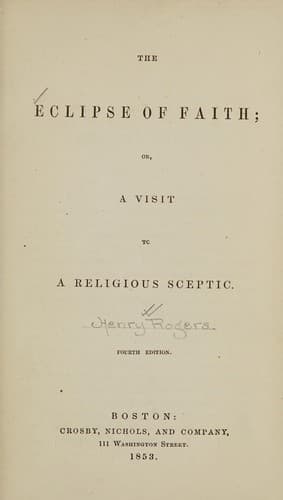
The Eclipse of Faith; Or, A Visit to a Religious Sceptic — John Shaqi
The Eclipse of Faith; Or, A Visit to a Religious ScepticRogers, Henry
Religion
The Eclipse of Faith; Or, A Visit to a Religious Sceptic
Rogers, Henry
Skepticism -- Controversial literature
"But if I asked you what were those of an animal, I presume you would
give those which both species possessed, and none that either
possessed exclusively."
"I should."
"Need I add, then, that you are deceiving yourself when you say that
you believe all the characteristic doctrines of Christianity, since you
say that you believe only those which it has in common with every
religion? If I were to ask you what doctrines are essential to
constitute any religion, then you would do well to enumerate those
which belong to Christianity and every other. But when we talk of the
doctrines peculiar to Christianity, we mean those which discriminate it
from every other, and not those which are common to it with them."
"But however," said Fellowes, "none of the doctrines you have enumerated
are a part of Christianity, but are mere additions of imposture or
fanaticism."
"Then what are the doctrines which, though common to every other
religion, are characteristic of it? What is left that is essential or
peculiar to Christianity, when you have denuded it of all that you
reject? Is it not then assimilated, by your own confession, to every
other religion? How shall we discriminate them?"
"By this, perhaps," said Fellowes, "(for I acknowledge some difficulty
here,) that Christianity contains these truths of absolute religion
alone and pure. As Mr. Parker says, This is the glory of genuine
Christianity."
"Do you not see that this is the very question,--you yourself being
obliged to reject nine tenths of the statements in the only records in
which we know anything about it? Might not an ancient priest of Jupiter
say the same of his religion, by first divesting it of all but that
which you say it had in common with every other? However, let us now
look at the positive side. What is the residuum which you condescend
to leave to your genuine Christianity?"
"Christianity," said Fellowes, rather pompously, "is not so much a
system as a discipline,--not a creed, but a life: in short, a divine
philosophy."
"All which I have heard from all sorts of Christianity a thousand
times," cried Harrington; "and it is delightfully vague; it may mean
any thing or nothing. But the truths, the truths, what are they, my
friend? I see I must get them from you by fragments. Your faith includes,
I presume, a belief in one Supreme God, who is a Divine Personality;
in the duty of reverencing, loving, and obeying him,--whether you know
how that is to be done or not; that we must repent of our sins,--if
indeed we duly know what things are sins in his sight; that he will
certainly forgive to any extent on such repentance, without any
mediation; that perhaps there is a heaven hereafter; but that it is
very doubtful if there are any punishments."
"I do believe," said Fellowes, "these are the cardinal doctrines of
the 'Absolute Religion,' as Mr. Parker calls it. Nor can I conceive
that any others are necessary."
Public-domain text, read in full here on John Shaqi.
Reviews
Reviews
No reviews yet
Be the first to share your thoughts on this work.
Join the Discussion
Join the discussion
Sign in to leave a comment or review.
Sign InorCreate an account