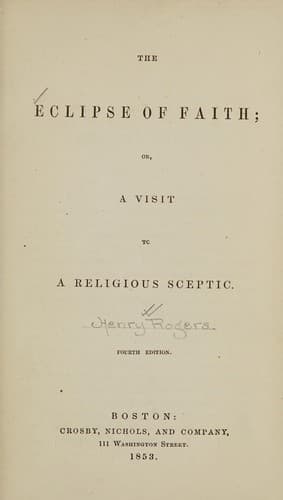
The Eclipse of Faith; Or, A Visit to a Religious Sceptic — John Shaqi
The Eclipse of Faith; Or, A Visit to a Religious ScepticRogers, Henry
Religion
The Eclipse of Faith; Or, A Visit to a Religious Sceptic
Rogers, Henry
Skepticism -- Controversial literature
"Only then?" said Harrington. "You were fortunate."
"He says, that to teach the certain speedy destruction of earthly things,
as the New Testament does, is to cut the sinews of all earthly progress;
to declare against intellect and imagination, against industrial and
social advancement."
My gravity was hardly equal to the task of listening to the first
part of Mr. Fellowes's speech. To hear that the common and just
reproach against all mankind, but especially against all Christians,
of taking too keen an interest in the present, was in a large measure
at least founded upon a mistake; to find, in fact, that there was some
danger of an excessive exaggeration of the claims of the future,
which required a corrective; that the Christian world, owing to the
above pernicious doctrine, might possibly evince too faint a relish
for the pleasures or too diminished an estimate for the advantages of
the present life; that, their "treasure being in heaven," it was not
impossible but "their heart" might be too much there also,--there,
perhaps, when it was imperatively demanded in the counting-house, on
the hustings, at the mart or the theatre; all this, being, as I say,
so notoriously contrary to ordinary opinion and experience, seemed to
me so exquisitely ludicrous that I could hardly help bursting into
laughter, especially as I imagined one of our new "spiritual" doctors
ascending the pulpit under the new dispensation, to indulge in
exhortations to a keener chase, of this world, and "the things of
this world." I found afterwards similar thoughts were passing through
Harrington's mind, rendered more whimsical by the recollection that,
during college life, his friend (though very far from vicious)
had certainly never seemed to take any deficient interest in the
affairs of this world, nor to exhibit any predilection for an
ascetic life. Indeed, he acknowledged that, after all, he could not
sympathize with Mr. Newman's extreme sensitiveness in relation to
this matter. (See Phases, p. 205.)
Public-domain text, read in full here on John Shaqi.
Reviews
Reviews
No reviews yet
Be the first to share your thoughts on this work.
Join the Discussion
Join the discussion
Sign in to leave a comment or review.
Sign InorCreate an account