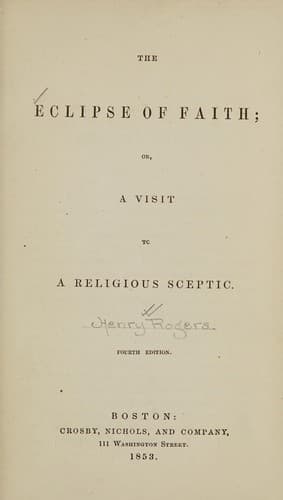
The Eclipse of Faith; Or, A Visit to a Religious ScepticRogers, Henry
Religion
The Eclipse of Faith; Or, A Visit to a Religious Sceptic
Rogers, Henry
Skepticism -- Controversial literature
July 9. Mr. Fellowes returned this morning. We had a very pleasant
day,--theology being excluded. In the evening my companions were
again pleased to disturb my occupations; but it was only a short
skirmish. Fellowes was endeavoring to enlighten his friend
respecting the mysteries of "belief" and "faith," as expounded by
some of his favorite writers: he contended, (making that sheer
separation between "the intellectual" and "spiritual," which so
many of the spiritual school affect.) not only that there may be
correct belief without true faith, which, in an intelligible sense,
few will deny; but that there may be a true faith with a false belief',
or even with none, in the strict sense of the word. Referring to a
recent acute writer in one of our religious periodicals, he argued
that belief is properly an intellectual process, founded on a presumed
preponderance of reasons or supposed reasons, for it; and that whether
those reasons amount to demonstration, or whether the scale be
turned by a grain, matters not; the product is purely logical, and
has no more to do with "faith" than a "belief" in any proposition
of Euclid.
"But, at all events," he proceeded, "whether you choose to call some
of these acts of reason by the name of belief or not, faith is
something quite independent of it. As Mr. Newman says, in his 'Phases,'
'Belief is one thing and faith another': 'belief is purely intellectual;
faith is properly spiritual.' 'Nowhere from any body of priests,
clergy, or ministers, as an order, is religious progress to be
anticipated till intellectual creeds are destroyed.' See, too, how
tenderly he speaks even of atheism. 'I do not know,' he says, 'how to
avoid calling this a moral error; but I must carefully guard against
seeming to overlook that it may still be a merely speculative error,
which ought not to separate our hearts from any man.' Similarly he
charitably restricts 'idolatry' in any 'bad sense' to a voluntary
worshipping of what the worshipper feels not to deserve his adoration;
and as I, for one, doubt whether this is ever the case, this delightful
charity is comprehensive indeed. Mr. Parker's discourse is full of
the same beautiful and tolerant maxims. 'Each religious doctrine,' he
says, 'has some time stood for a truth ...... Each of these forms of
religion (polytheism and fetichism, to wit) did the world service
in its day.' No one form of religion is absolutely true; faith may
be compatible with them all."
"Let me understand you, if possible," said Harrington; "for at present
I fear I do not. That there may be belief without faith in a very
Intelligible sense, I can understand. You say there can be faith without
belief, and a true faith that is connected with any belief, however
erroneous, do you not?"
"Provided it contains the absolute religion."
"Well, and even the lowest fetichism does that, according to Mr. Parker,
whom you defend. Now this Protean faith is what I do not understand."
Public-domain text, read in full here on John Shaqi.
Reviews
Reviews
No reviews yet
Be the first to share your thoughts on this work.
Elsewhere in the archive
Join the Discussion
Join the discussion
Sign in to leave a comment or review.
Sign InorCreate an account