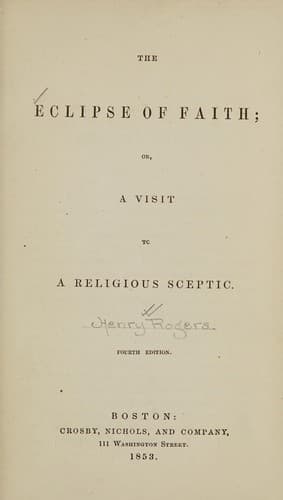
The Eclipse of Faith; Or, A Visit to a Religious ScepticRogers, Henry
Religion
The Eclipse of Faith; Or, A Visit to a Religious Sceptic
Rogers, Henry
Skepticism -- Controversial literature
"That," said Fellowes, "I can easily conceive; and, let me add, no
sceptic can understand it."
"I see no reason why he should not," said Harrington, laughing, "if,
as you and Mr. Newman suppose, the 'spiritual' can be so perfectly
divorced from the 'intellectual.' According to your reasoning, the
and the idolater cannot be incapable of exercising this mysterious
'faith,'--when their errors are supposed purely speculative,--since
faith has nothing to do with the intellect; neither therefore ought
the sceptic to be quite beyond the pale of your charity. Nay, his
intellect being a rasa tabula in these matters, I should think he is
in more favorable circumstances than they can be. But, seriously, let
me try, if possible, to fathom this curious dogma,--I beg your
pardon,--sentiment, I mean. Belief without faith in an intelligible
sense (if by this last we mean a condition of the emotions or
affections), I can understand; though if the truth believed be of a
nature to excite to emotion and to dictate action, and fail to do so,
I doubt whether men in general would not call that belief spurious. For
example, if a man, on being told that his house was on fire, sat still
in his neighbor's chimney-corner, and took no notice of the matter,
most persons would say that his assent was no true belief; for it did
not produce its effects, did not produce faith. But whether faith can
ever exist independently of belief,--whether it is not always involved
with it,--and whether there can be a faith worth a farthing that is
not based on a true belief,--that is the point on which I want light.
If I understand you, an acceptable faith may or may not coexist
with a true belief; and men who believe in Jupiter or Jehovah, in one
God or a thousand, who worship the sun, or an idol, or a cat, or a
monkey, all may have an equally acceptable faith."
"I affirm it."
"That as there may be belief in a truth without faith, so there may
be faith, though the intellect believes in a falsehood;--that faith,
in fact, is independent of knowledge, or of any particular condition
of the intellect?"
"I do not like the terms in which you express the sentiment, but I,
for one, believe it substantially correct."
"Never mind the form; I am quite willing to employ other terms, if you
will supply them"
"Well, then," said Fellowes, "I should say, with Mr. Parker, that
the principle of true faith may be found to coexist with the grossest
and most hideous misconceptions of God, while the absence of it may
coexist with the truest and most elevated belief."
Public-domain text, read in full here on John Shaqi.
Reviews
Reviews
No reviews yet
Be the first to share your thoughts on this work.
Elsewhere in the archive
Join the Discussion
Join the discussion
Sign in to leave a comment or review.
Sign InorCreate an account