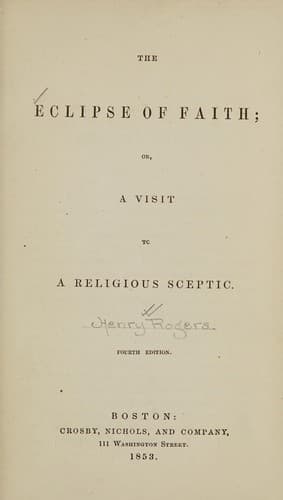
The Eclipse of Faith; Or, A Visit to a Religious ScepticRogers, Henry
Religion
The Eclipse of Faith; Or, A Visit to a Religious Sceptic
Rogers, Henry
Skepticism -- Controversial literature
The degree to which the infection tainted the clergy was no
criterion at all of the sympathy of the people. Too many of the
former were easily converted to a system which confirmed all their
ecclesiastical prejudices, and favored their sacerdotal pretensions;
which endowed every youngster upon whom the bishop laid hands
with "preternatural graces," and with the power of working
"spiritual miracles." But the people generally were in little
danger of being misled by these absurdities; and facts, even before
the recent outbreak, ought to have convinced the clergy, that, if
they thought proper to go to Rome, their flocks were by no means
prepared to follow them. Except among some fashionable folks here
and there,--young ladies to whom ennui, susceptible nerves, and a
sentimental imagination made any sort of excitement acceptable;
who turned their arks of embroidery and painting, and their love
of music, to "spiritual" uses, and displayed their piety and their
accomplishments at the same time,--except among these, I say, and
those amongst the more ignorant of our rural population whom such
people influenced, the Anglican movement could not boast of any
signal success. In the more densely peopled districts, and amongst
the middle classes especially, the failure of the thing was often
most ignominious. No sooner were the candles placed upon the
"altar" than the congregation began to thin; and by the time the
"obsolete" rubrics were all admirably observed, the priest
faultlessly arrayed, the service properly intoned, and the entire
"spiritual" machine set in motion, the people were apt to desert
the sacred edifice altogether. It was a pity, doubtless, that,
when such admirable completeness in the ecclesiastical, equipments
had been attained, it should be found that the machine would not
work; that just when the Church became perfect, it should fail for
so insignificant an accident as the want of a congregation. Yet so
it often was. The ecclesiastical play was an admirable rehearsal,
and nothing more. Not but what there are many priests who would
prefer a "full service," and an ample ceremonial in an empty
church, to the simple Gospel in a crowded one; like Handel, who
consoled himself with the vacant benches at one of his oratorios
by saying that "dey made de music sound de ner." And, in truth,
if we adopt to the full the "High Church" theory, perhaps it
cannot much matter whether the people be present or not; the opus
operatum of magic rites and spiritual conjuration may be equally
effectual. The Oxford tracts said ten years ago, "Before the
Reformation, the Church recognized the seven hours of prayer;
however these may have been practically neglected, or hidden
in an unknown tongue, there is no estimating what influence this
may have had on common people's minds secretly." Surely you must
agree that there is no estimating the efficacy of nobody's
hearing services which, if heard by any body, would have been
in an unknown tongue.
Public-domain text, read in full here on John Shaqi.
Reviews
Reviews
No reviews yet
Be the first to share your thoughts on this work.
Join the Discussion
Join the discussion
Sign in to leave a comment or review.
Sign InorCreate an account