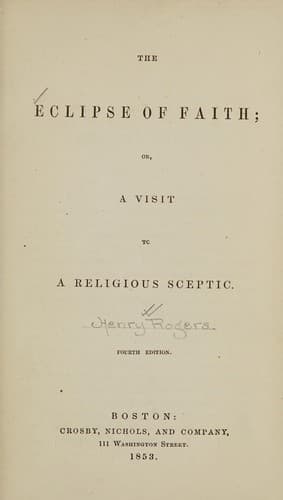
The Eclipse of Faith; Or, A Visit to a Religious ScepticRogers, Henry
Religion
The Eclipse of Faith; Or, A Visit to a Religious Sceptic
Rogers, Henry
Skepticism -- Controversial literature
"It is ingeniously put, I admit. I grant that there are here, as in
so many other cases, limits which, though it may not be very easy
to assign them, as plainly exist. But that does not answer my
question. I want to know whether the principle is to be applied
without limits at all, as your speculative theory demands? In other
words, will it or not sanctify acts of the most degrading and
pernicious idolatry, of the most debasing superstition, because
allied to that state of the affections in which you make the essence
of faith consist? If it will not, then your objection to me is
nothing; it merely asks me to assign limits within which the exercise
of the affection in question may be acceptable, or almost equally
acceptable, in cases of a partially enlightened understanding. If it
will, then it leaves you open, as I conceive, and fairly open, to all
the objections which have been so brusquely urged against you by your
friend, in whose indignant protest against the detestable apologies for
the lowest forms of religious degradation, in which so many 'spiritual'
writers indulge, I for one heartily sympathize."
I ventured to add, that the account of "faith" as a state of the
emotions exclusively, given by some of his favorite writers, is
perfectly arbitrary. "Belief," say they, "is wholly intellectual: faith
is wholly moral." Now it would be of very little consequence, if the
terms be generally so understood, whether they be so used or not; men
would, in that case, suppose that faith, thus restricted, implies a
previous process of mind which is to be called exclusively belief. I
added, however, that I did not believe that the word faith was ever
thus understood in popular use; but that, on the contrary, it was
employed to imply belief founded on knowledge, or supposed knowledge,
and, where the belief was, in its very nature, practical, or involved
emotion, a conduct and a state of the affections corresponding thereto.
"But this," said I, "merely respects the Popular use of the words, and
if is hardly worth while to prolong discussion on it. As to the
reasoning which would show that belief does not properly exist at
all, because it may be all resolved into reason, founded on the
preponderance of evidence, where it does not matter whether that
preponderance be a ton or a scruple,--surely it is over-refined. Men
will always feel that there is a marked difference between the states
of mind in which they assent to a proposition of which they have no
more doubt than they have of their own existence, or to a proposition
in the mathematics, and to one in which they feel that only a few
grains turn the scale. To this conscious difference in the condition
of mind, they have given (and I suppose will not give) very different
names; and though they will continue to say that they believe that two
and two make four, but that they know it, they will say that they
believe that they will die before the end of the century, though they
Public-domain text, read in full here on John Shaqi.
Reviews
Reviews
No reviews yet
Be the first to share your thoughts on this work.
Elsewhere in the archive
Join the Discussion
Join the discussion
Sign in to leave a comment or review.
Sign InorCreate an account