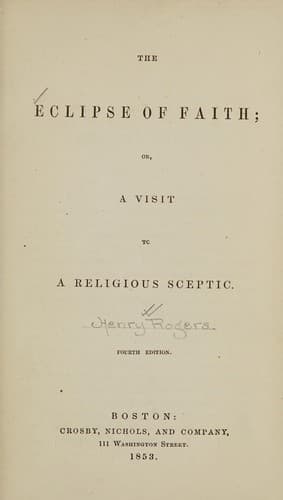
The Eclipse of Faith; Or, A Visit to a Religious ScepticRogers, Henry
Religion
The Eclipse of Faith; Or, A Visit to a Religious Sceptic
Rogers, Henry
Skepticism -- Controversial literature
will not say that they know that. The distinction between the certain
and the probable is felt to be far too important not to be marked by
corresponding varieties of speech; and speech has made them according."
____
July 10. This morning Harrington fulfilled his promise of acquainting
me with a few of the reasons which prevented his taking refuge in the
"half-way houses" between the Bible and Religious Scepticism. Mr. Fellowes
was an attentive listener. Harrington had entitled his paper,--
REASONS FOR DECLINING THE VIA MEDIA BETWEEN REVEALED RELIGION AND
ATHEISM--OR SCEPTICISM WITH SPECIAL REFERENCE TO THE THEORIES OF
MR. THEODORE PARKER AND MR. FRANCIS NEWMAN.
I shall be brief; not being solicitous to suggest doubts to others,
but merely to justify my own.
Both Mr. Parker and Mr. Newman make themselves very merry with a
"book-revelation," as they call it; and if they had given any thing
better,--more rational or more certain than the Bible,--how gladly
could I have joined in the ridicule! As it is, I doubt the solidity
of the theories they support, and hardly doubt that, if the principles
on which they reject the Bible be sound, they ought to go much farther.
Both affirm the absurdity of a special external revelation to man;
both, that the fountain of spiritual illumination is exclusively
from within, and not from without. A few brief citations will set
this point in a clear light. "Religion itself." says Mr. Parker,
"must be the same thing in each man; not a similar thing, but just
the same; differing only in degree."* "The Idea of God, as a fact
given in man's nature, is permanent and alike in all; while the
sentiment of God, though vague and mysterious, is always the same in
itself." (ibid. p. 21)--"Of course, then, there is no difference but
of words between revealed Religion and natural Religion; for all actual
Religion is revealed in us, or it could not be felt." (ibid. p. 33). The
Absolute Religion, which he affirms to be universally known, he defines
as "Voluntary Obedience to the Law of God,--inward and outward Obedience
to that law he has written on our nature, revealed in various ways
through Instinct, Reason, Conscience, and the Religious Sentiment."
(ibid. p. 34). Similarly, Mr. Newman says, "What God reveals to us he
reveals within, through the medium of our moral and spiritual senses."
(Soul, p. 59) "Christianity itself has practically confessed, what is
theoretically clear,"--you must take his word for both,--"that an
authoritative external revelation of moral and spiritual truth is
essentially impossible to man." (Soul, p. 59) "No book-revelation can
(without sapping its own pedestal) authoritatively dictate laws of human
virtue, or alter our a priori view of the Divine character." (Ibid. p.
58)
----
* Discourses of Matters pertaining to Religion, p. 36.
----
Public-domain text, read in full here on John Shaqi.
Reviews
Reviews
No reviews yet
Be the first to share your thoughts on this work.
Elsewhere in the archive
Join the Discussion
Join the discussion
Sign in to leave a comment or review.
Sign InorCreate an account