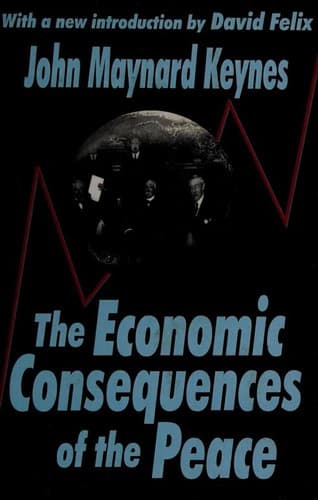
The Economic Consequences of the PeaceKeynes, John Maynard
History
The Economic Consequences of the Peace
Keynes, John Maynard
Economic history -- 1918-1945; Treaty of Versailles (1919 June 28); World War, 1914-1918 -- Economic aspects
The powers and constitution of the Reparation Commission are mainly laid
down in Articles 233-241 and Annex II. of the Reparation Chapter of the
Treaty with Germany. But the same Commission is to exercise authority
over Austria and Bulgaria, and possibly over Hungary and Turkey, when
Peace is made with these countries. There are, therefore, analogous
articles _mutatis mudandis_ in the Austrian Treaty[135] and in the
Bulgarian Treaty.[136]
The principal Allies are each represented by one chief delegate.
The delegates of the United States, Great Britain, France, and
Italy take part in all proceedings; the delegate of Belgium in all
proceedings except those attended by the delegates of Japan or the
Serb-Croat-Slovene State; the delegate of Japan in all proceedings
affecting maritime or specifically Japanese questions; and the
delegate of the Serb-Croat-Slovene State when questions relating to
Austria, Hungary, or Bulgaria are under consideration. Other allies
are to be represented by delegates, without the power to vote,
whenever their respective claims and interests are under examination.
In general the Commission decides by a majority vote, except in certain
specific cases where unanimity is required, of which the most important
are the cancellation of German indebtedness, long postponement of the
instalments, and the sale of German bonds of indebtedness. The
Commission is endowed with full executive authority to carry out its
decisions. It may set up an executive staff and delegate authority to
its officers. The Commission and its staff are to enjoy diplomatic
privileges, and its salaries are to be paid by Germany, who will,
however, have no voice in fixing them, If the Commission is to discharge
adequately its numerous functions, it will be necessary for it to
establish a vast polyglot bureaucratic organization, with a staff of
hundreds. To this organization, the headquarters of which will be in
Paris, the economic destiny of Central Europe is to be entrusted.
Its main functions are as follows:--
1. The Commission will determine the precise figure of the claim against
the enemy Powers by an examination in detail of the claims of each of
the Allies under Annex I. of the Reparation Chapter. This task must be
completed by May, 1921. It shall give to the German Government and to
Germany's allies "a just opportunity to be heard, but not to take any
part whatever in the decisions of the Commission." That is to say, the
Commission will act as a party and a judge at the same time.
2. Having determined the claim, it will draw up a schedule of payments
providing for the discharge of the whole sum with interest within thirty
years. From time to time it shall, with a view to modifying the schedule
within the limits of possibility, "consider the resources and capacity
of Germany ... giving her representatives a just opportunity to be heard."
Public-domain text, read in full here on John Shaqi.
Reviews
Reviews
No reviews yet
Be the first to share your thoughts on this work.
Elsewhere in the archive
Join the Discussion
Join the discussion
Sign in to leave a comment or review.
Sign InorCreate an account