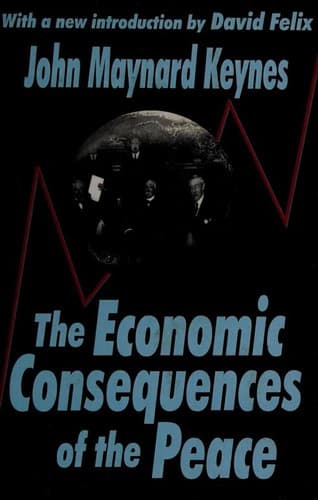
The Economic Consequences of the Peace — John Shaqi
The Economic Consequences of the PeaceKeynes, John Maynard
History
The Economic Consequences of the Peace
Keynes, John Maynard
Economic history -- 1918-1945; Treaty of Versailles (1919 June 28); World War, 1914-1918 -- Economic aspects
When first the virgin soils of America came into bearing, the
proportions of the population of those continents themselves, and
consequently of their own local requirements, to those of Europe were
very small. As lately as 1890 Europe had a population three times that
of North and South America added together. But by 1914 the domestic
requirements of the United States for wheat were approaching their
production, and the date was evidently near when there would be an
exportable surplus only in years of exceptionally favorable harvest.
Indeed, the present domestic requirements of the United States are
estimated at more than ninety per cent of the average yield of the five
years 1909-1913.[5] At that time, however, the tendency towards
stringency was showing itself, not so much in a lack of abundance as in
a steady increase of real cost. That is to say, taking the world as a
whole, there was no deficiency of wheat, but in order to call forth an
adequate supply it was necessary to offer a higher real price. The most
favorable factor in the situation was to be found in the extent to which
Central and Western Europe was being fed from the exportable surplus of
Russia and Roumania.
In short, Europe's claim on the resources of the New World was becoming
precarious; the law of diminishing returns was at last reasserting
itself and was making it necessary year by year for Europe to offer a
greater quantity of other commodities to obtain the same amount of
bread; and Europe, therefore, could by no means afford the
disorganization of any of her principal sources of supply.
Much else might be said in an attempt to portray the economic
peculiarities of the Europe of 1914. I have selected for emphasis the
three or four greatest factors of instability,--the instability of an
excessive population dependent for its livelihood on a complicated and
artificial organization, the psychological instability of the laboring
and capitalist classes, and the instability of Europe's claim, coupled
with the completeness of her dependence, on the food supplies of the New
World.
The war had so shaken this system as to endanger the life of Europe
altogether. A great part of the Continent was sick and dying; its
population was greatly in excess of the numbers for which a livelihood
was available; its organization was destroyed, its transport system
ruptured, and its food supplies terribly impaired.
It was the task of the Peace Conference to honor engagements and to
satisfy justice; but not less to re-establish life and to heal wounds.
These tasks were dictated as much by prudence as by the magnanimity
which the wisdom of antiquity approved in victors. We will examine in
the following chapters the actual character of the Peace.
FOOTNOTES:
[1] In 1913 there were 25,843 emigrants from Germany, of whom
19,124 went to the United States.
Public-domain text, read in full here on John Shaqi.
Reviews
Reviews
No reviews yet
Be the first to share your thoughts on this work.
Join the Discussion
Join the discussion
Sign in to leave a comment or review.
Sign InorCreate an account