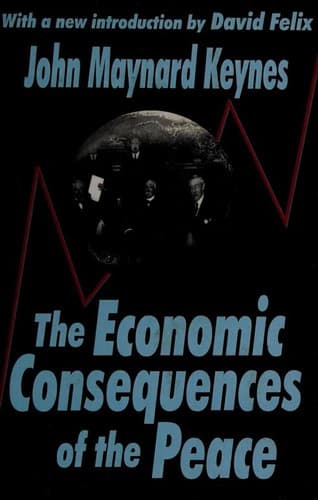
The Economic Consequences of the PeaceKeynes, John Maynard
History
The Economic Consequences of the Peace
Keynes, John Maynard
Economic history -- 1918-1945; Treaty of Versailles (1919 June 28); World War, 1914-1918 -- Economic aspects
We are thus faced in Europe with the spectacle of an extraordinary
weakness on the part of the great capitalist class, which has emerged
from the industrial triumphs of the nineteenth century, and seemed a
very few years ago our all-powerful master. The terror and personal
timidity of the individuals of this class is now so great, their
confidence in their place in society and in their necessity to the
social organism so diminished, that they are the easy victims of
intimidation. This was not so in England twenty-five years ago, any
more than it is now in the United States. Then the capitalists believed
in themselves, in their value to society, in the propriety of their
continued existence in the full enjoyment of their riches and the
unlimited exercise of their power. Now they tremble before every
insult;--call them pro-Germans, international financiers, or profiteers,
and they will give you any ransom you choose to ask not to speak of them
so harshly. They allow themselves to be ruined and altogether undone by
their own instruments, governments of their own making, and a press of
which they are the proprietors. Perhaps it is historically true that no
order of society ever perishes save by its own hand. In the complexer
world of Western Europe the Immanent Will may achieve its ends more
subtly and bring in the revolution no less inevitably through a Klotz or
a George than by the intellectualisms, too ruthless and self-conscious
for us, of the bloodthirsty philosophers of Russia.
The inflationism of the currency systems of Europe has proceeded to
extraordinary lengths. The various belligerent Governments, unable, or
too timid or too short-sighted to secure from loans or taxes the
resources they required, have printed notes for the balance. In Russia
and Austria-Hungary this process has reached a point where for the
purposes of foreign trade the currency is practically valueless. The
Polish mark can be bought for about three cents and the Austrian crown
for less than two cents, but they cannot be sold at all. The German mark
is worth less than four cents on the exchanges. In most of the other
countries of Eastern and South-Eastern Europe the real position is
nearly as bad. The currency of Italy has fallen to little more than a
half of its nominal value in spite of its being still subject to some
degree of regulation; French currency maintains an uncertain market; and
even sterling is seriously diminished in present value and impaired in
its future prospects.
Public-domain text, read in full here on John Shaqi.
Reviews
Reviews
No reviews yet
Be the first to share your thoughts on this work.
Elsewhere in the archive
Join the Discussion
Join the discussion
Sign in to leave a comment or review.
Sign InorCreate an account