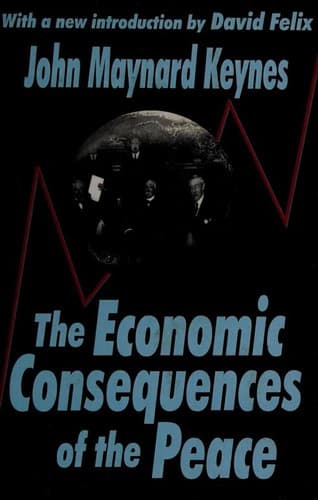
The Economic Consequences of the PeaceKeynes, John Maynard
History
The Economic Consequences of the Peace
Keynes, John Maynard
Economic history -- 1918-1945; Treaty of Versailles (1919 June 28); World War, 1914-1918 -- Economic aspects
But while these currencies enjoy a precarious value abroad, they have
never entirely lost, not even in Russia, their purchasing power at home.
A sentiment of trust in the legal money of the State is so deeply
implanted in the citizens of all countries that they cannot but believe
that some day this money must recover a part at least of its former
value. To their minds it appears that value is inherent in money as
such, and they do not apprehend that the real wealth, which this money
might have stood for, has been dissipated once and for all. This
sentiment is supported by the various legal regulations with which the
Governments endeavor to control internal prices, and so to preserve some
purchasing power for their legal tender. Thus the force of law
preserves a measure of immediate purchasing power over some commodities
and the force of sentiment and custom maintains, especially amongst
peasants, a willingness to hoard paper which is really worthless.
The presumption of a spurious value for the currency, by the force of
law expressed in the regulation of prices, contains in itself, however,
the seeds of final economic decay, and soon dries up the sources of
ultimate supply. If a man is compelled to exchange the fruits of his
labors for paper which, as experience soon teaches him, he cannot use to
purchase what he requires at a price comparable to that which he has
received for his own products, he will keep his produce for himself,
dispose of it to his friends and neighbors as a favor, or relax his
efforts in producing it. A system of compelling the exchange of
commodities at what is not their real relative value not only relaxes
production, but leads finally to the waste and inefficiency of barter.
If, however, a government refrains from regulation and allows matters to
take their course, essential commodities soon attain a level of price
out of the reach of all but the rich, the worthlessness of the money
becomes apparent, and the fraud upon the public can be concealed no
longer.
The effect on foreign trade of price-regulation and profiteer-hunting
as cures for inflation is even worse. Whatever may be the case at home,
the currency must soon reach its real level abroad, with the result that
prices inside and outside the country lose their normal adjustment. The
price of imported commodities, when converted at the current rate of
exchange, is far in excess of the local price, so that many essential
goods will not be imported at all by private agency, and must be
provided by the government, which, in re-selling the goods below cost
price, plunges thereby a little further into insolvency. The bread
subsidies, now almost universal throughout Europe, are the leading
example of this phenomenon.
Public-domain text, read in full here on John Shaqi.
Reviews
Reviews
No reviews yet
Be the first to share your thoughts on this work.
Elsewhere in the archive
Join the Discussion
Join the discussion
Sign in to leave a comment or review.
Sign InorCreate an account