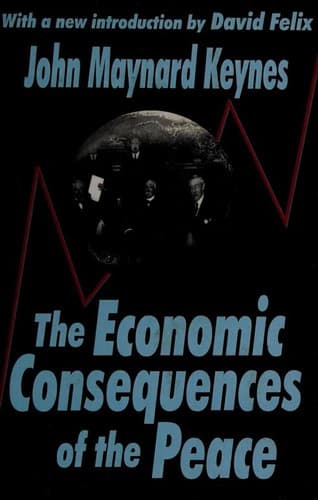
The Economic Consequences of the PeaceKeynes, John Maynard
History
The Economic Consequences of the Peace
Keynes, John Maynard
Economic history -- 1918-1945; Treaty of Versailles (1919 June 28); World War, 1914-1918 -- Economic aspects
[154] On October 3, 1919, M. Bilinski made his financial
statement to the Polish Diet. He estimated his expenditure for the next
nine months at rather more than double his expenditure for the past nine
months, and while during the first period his revenue had amounted to
one-fifth of his expenditure, for the coming months he was budgeting for
receipts equal to one-eighth of his outgoings. The _Times_ correspondent
at Warsaw reported that "in general M. Bilinski's tone was optimistic
and appeared to satisfy his audience."
[155] The terms of the Peace Treaty imposed on the Austrian
Republic bear no relation to the real facts of that State's desperate
situation. The _Arbeiter Zeitung_ of Vienna on June 4, 1919, commented
on them as follows: "Never has the substance of a treaty of peace so
grossly betrayed the intentions which were said to have guided its
construction as is the case with this Treaty ... in which every provision
is permeated with ruthlessness and pitilessness, in which no breath of
human sympathy can be detected, which flies in the face of everything
which binds man to man, which is a crime against humanity itself,
against a suffering and tortured people." I am acquainted in detail with
the Austrian Treaty and I was present when some of its terms were being
drafted, but I do not find it easy to rebut the justice of this
outburst.
[156] For months past the reports of the health conditions in
the Central Empires have been of such a character that the imagination
is dulled, and one almost seems guilty of sentimentality in quoting
them. But their general veracity is not disputed, and I quote the three
following, that the reader may not be unmindful of them: "In the last
years of the war, in Austria alone at least 35,000 people died of
tuberculosis, in Vienna alone 12,000. Today we have to reckon with a
number of at least 350,000 to 400,000 people who require treatment for
tuberculosis.... As the result of malnutrition a bloodless generation is
growing up with undeveloped muscles, undeveloped joints, and undeveloped
brain" (_Neue Freie Presse_, May 31, 1919). The Commission of Doctors
appointed by the Medical Faculties of Holland, Sweden, and Norway to
examine the conditions in Germany reported as follows in the Swedish
Press in April, 1919: "Tuberculosis, especially in children, is
increasing in an appalling way, and, generally speaking, is malignant.
In the same way rickets is more serious and more widely prevalent. It is
impossible to do anything for these diseases; there is no milk for the
tuberculous, and no cod-liver oil for those suffering from rickets....
Tuberculosis is assuming almost unprecedented aspects, such as have
hitherto only been known in exceptional cases. The whole body is
attacked simultaneously, and the illness in this form is practically
incurable.... Tuberculosis is nearly always fatal now among adults. It
is the cause of 90 per cent of the hospital cases. Nothing can be done
Public-domain text, read in full here on John Shaqi.
Reviews
Reviews
No reviews yet
Be the first to share your thoughts on this work.
Elsewhere in the archive
Join the Discussion
Join the discussion
Sign in to leave a comment or review.
Sign InorCreate an account