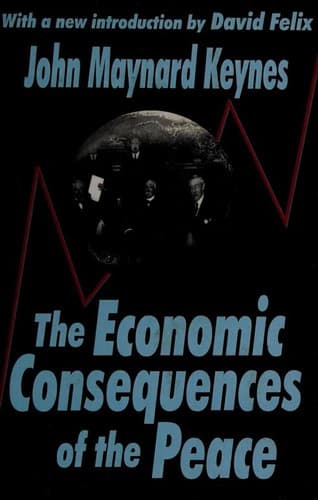
The Economic Consequences of the PeaceKeynes, John Maynard
History
The Economic Consequences of the Peace
Keynes, John Maynard
Economic history -- 1918-1945; Treaty of Versailles (1919 June 28); World War, 1914-1918 -- Economic aspects
In the chapters of this book I have not generally had in mind the
situation or the problems of England. "Europe" in my narration must
generally be interpreted to exclude the British Isles. England is in a
state of transition, and her economic problems are serious. We may be on
the eve of great changes in her social and industrial structure. Some of
us may welcome such prospects and some of us deplore them. But they are
of a different kind altogether from those impending on Europe. I do not
perceive in England the slightest possibility of catastrophe or any
serious likelihood of a general upheaval of society. The war has
impoverished us, but not seriously;--I should judge that the real wealth
of the country in 1919 is at least equal to what it was in 1900. Our
balance of trade is adverse, but not so much so that the readjustment of
it need disorder our economic life.[157] The deficit in our Budget is
large, but not beyond what firm and prudent statesmanship could bridge.
The shortening of the hours of labor may have somewhat diminished our
productivity. But it should not be too much to hope that this is a
feature of transition, and no one who is acquainted with the British
workingman can doubt that, if it suits him, and if he is in sympathy and
reasonable contentment with the conditions of his life, he can produce
at least as much in a shorter working day as he did in the longer hours
which prevailed formerly. The most serious problems for England have
been brought to a head by the war, but are in their origins more
fundamental. The forces of the nineteenth century have run their course
and are exhausted. The economic motives and ideals of that generation no
longer satisfy us: we must find a new way and must suffer again the
_malaise_, and finally the pangs, of a new industrial birth. This is one
element. The other is that on which I have enlarged in Chapter II.;--the
increase in the real cost of food and the diminishing response of nature
to any further increase in the population of the world, a tendency which
must be especially injurious to the greatest of all industrial
countries and the most dependent on imported supplies of food.
But these secular problems are such as no age is free from. They are of
an altogether different order from those which may afflict the peoples
of Central Europe. Those readers who, chiefly mindful of the British
conditions with which they are familiar, are apt to indulge their
optimism, and still more those whose immediate environment is American,
must cast their minds to Russia, Turkey, Hungary, or Austria, where the
most dreadful material evils which men can suffer--famine, cold,
disease, war, murder, and anarchy--are an actual present experience, if
they are to apprehend the character of the misfortunes against the
further extension of which it must surely be our duty to seek the
remedy, if there is one.
Public-domain text, read in full here on John Shaqi.
Reviews
Reviews
No reviews yet
Be the first to share your thoughts on this work.
Elsewhere in the archive
Join the Discussion
Join the discussion
Sign in to leave a comment or review.
Sign InorCreate an account