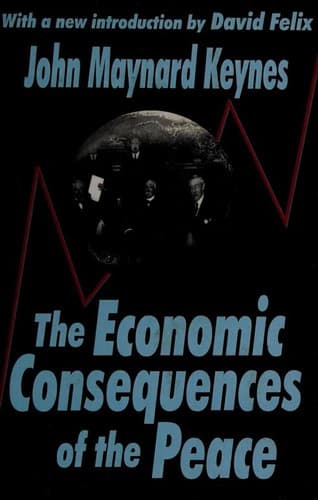
The Economic Consequences of the PeaceKeynes, John Maynard
History
The Economic Consequences of the Peace
Keynes, John Maynard
Economic history -- 1918-1945; Treaty of Versailles (1919 June 28); World War, 1914-1918 -- Economic aspects
What then is to be done? The tentative suggestions of this chapter may
appear to the reader inadequate. But the opportunity was missed at Paris
during the six months which followed the Armistice, and nothing we can
do now can repair the mischief wrought at that time. Great privation and
great risks to society have become unavoidable. All that is now open to
us is to redirect, so far as lies in our power, the fundamental economic
tendencies which underlie the events of the hour, so that they promote
the re-establishment of prosperity and order, instead of leading us
deeper into misfortune.
We must first escape from the atmosphere and the methods of Paris. Those
who controlled the Conference may bow before the gusts of popular
opinion, but they will never lead us out of our troubles. It is hardly
to be supposed that the Council of Four can retrace their steps, even if
they wished to do so. The replacement of the existing Governments of
Europe is, therefore, an almost indispensable preliminary.
I propose then to discuss a program, for those who believe that the
Peace of Versailles cannot stand, under the following heads:
1. The Revision of the Treaty.
2. The settlement of inter-Ally indebtedness.
3. An international loan and the reform of the currency.
4. The relations of Central Europe to Russia.
1. _The Revision of the Treaty_
Are any constitutional means open to us for altering the Treaty?
President Wilson and General Smuts, who believe that to have secured the
Covenant of the League of Nations outweighs much evil in the rest of the
Treaty, have indicated that we must look to the League for the gradual
evolution of a more tolerable life for Europe. "There are territorial
settlements," General Smuts wrote in his statement on signing the Peace
Treaty, "which will need revision. There are guarantees laid down which
we all hope will soon be found out of harmony with the new peaceful
temper and unarmed state of our former enemies. There are punishments
foreshadowed over most of which a calmer mood may yet prefer to pass the
sponge of oblivion. There are indemnities stipulated which cannot be
enacted without grave injury to the industrial revival of Europe, and
which it will be in the interests of all to render more tolerable and
moderate.... I am confident that the League of Nations will yet prove
the path of escape for Europe out of the ruin brought about by this
war." Without the League, President Wilson informed the Senate when he
presented the Treaty to them early in July, 1919, "...long-continued
supervision of the task of reparation which Germany was to undertake to
complete within the next generation might entirely break down;[158] the
reconsideration and revision of administrative arrangements and
restrictions which the Treaty prescribed, but which it recognized might
not provide lasting advantage or be entirely fair if too long enforced,
would be impracticable."
Public-domain text, read in full here on John Shaqi.
Reviews
Reviews
No reviews yet
Be the first to share your thoughts on this work.
Elsewhere in the archive
Join the Discussion
Join the discussion
Sign in to leave a comment or review.
Sign InorCreate an account