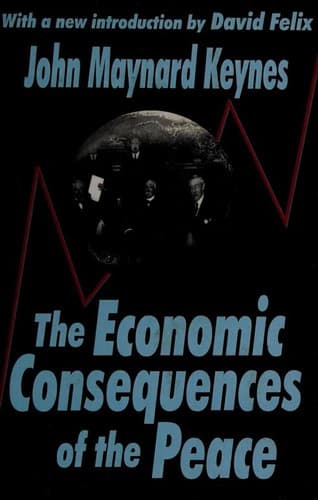
The Economic Consequences of the PeaceKeynes, John Maynard
History
The Economic Consequences of the Peace
Keynes, John Maynard
Economic history -- 1918-1945; Treaty of Versailles (1919 June 28); World War, 1914-1918 -- Economic aspects
Can we look forward with fair hopes to securing from the operation of
the League those benefits which two of its principal begetters thus
encourage us to expect from it? The relevant passage is to be found in
Article XIX. of the Covenant, which runs as follows:
"The Assembly may from time to time advise the
reconsideration by Members of the League of treaties which
have become inapplicable and the consideration of
international conditions whose continuance might endanger the
peace of the world."
But alas! Article V. provides that "Except where otherwise expressly
provided in this Covenant or by the terms of the present Treaty,
decisions at any meeting of the Assembly or of the Council shall require
the agreement of all the Members of the League represented at the
meeting." Does not this provision reduce the League, so far as concerns
an early reconsideration of any of the terms of the Peace Treaty, into a
body merely for wasting time? If all the parties to the Treaty are
unanimously of opinion that it requires alteration in a particular
sense, it does not need a League and a Covenant to put the business
through. Even when the Assembly of the League is unanimous it can only
"advise" reconsideration by the members specially affected.
But the League will operate, say its supporters, by its influence on the
public opinion of the world, and the view of the majority will carry
decisive weight in practice, even though constitutionally it is of no
effect. Let us pray that this be so. Yet the League in the hands of the
trained European diplomatist may become an unequaled instrument for
obstruction and delay. The revision of Treaties is entrusted primarily,
not to the Council, which meets frequently, but to the Assembly, which
will meet more rarely and must become, as any one with an experience of
large Inter-Ally Conferences must know, an unwieldy polyglot debating
society in which the greatest resolution and the best management may
fail altogether to bring issues to a head against an opposition in favor
of the _status quo_. There are indeed two disastrous blots on the
Covenant,--Article V., which prescribes unanimity, and the
much-criticized Article X., by which "The Members of the League
undertake to respect and preserve as against external aggression the
territorial integrity and existing political independence of all Members
of the League." These two Articles together go some way to destroy the
conception of the League as an instrument of progress, and to equip it
from the outset with an almost fatal bias towards the _status quo_. It
is these Articles which have reconciled to the League some of its
original opponents, who now hope to make of it another Holy Alliance for
the perpetuation of the economic ruin of their enemies and the Balance
of Power in their own interests which they believe themselves to have
established by the Peace.
Public-domain text, read in full here on John Shaqi.
Reviews
Reviews
No reviews yet
Be the first to share your thoughts on this work.
Elsewhere in the archive
Join the Discussion
Join the discussion
Sign in to leave a comment or review.
Sign InorCreate an account