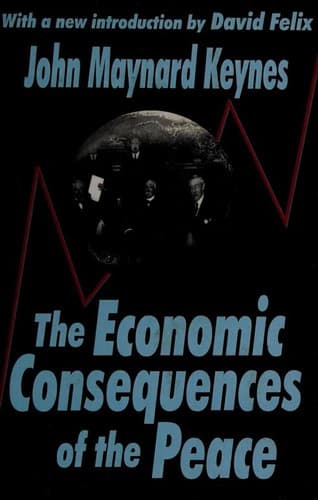
The Economic Consequences of the PeaceKeynes, John Maynard
History
The Economic Consequences of the Peace
Keynes, John Maynard
Economic history -- 1918-1945; Treaty of Versailles (1919 June 28); World War, 1914-1918 -- Economic aspects
The final consideration influencing the reader's attitude to this
proposal must, however, depend on his view as to the future place in the
world's progress of the vast paper entanglements which are our legacy
from war finance both at home and abroad. The war has ended with every
one owing every one else immense sums of money. Germany owes a large sum
to the Allies, the Allies owe a large sum to Great Britain, and Great
Britain owes a large sum to the United States. The holders of war loan
in every country are owed a large sum by the State, and the State in its
turn is owed a large sum by these and other taxpayers. The whole
position is in the highest degree artificial, misleading, and vexatious.
We shall never be able to move again, unless we can free our limbs from
these paper shackles. A general bonfire is so great a necessity that
unless we can make of it an orderly and good-tempered affair in which no
serious injustice is done to any one, it will, when it comes at last,
grow into a conflagration that may destroy much else as well. As regards
internal debt, I am one of those who believe that a capital levy for the
extinction of debt is an absolute prerequisite of sound finance in
everyone of the European belligerent countries. But the continuance on a
huge scale of indebtedness between Governments has special dangers of
its own.
Before the middle of the nineteenth century no nation owed payments to a
foreign nation on any considerable scale, except such tributes as were
exacted under the compulsion of actual occupation in force and, at one
time, by absentee princes under the sanctions of feudalism. It is true
that the need for European capitalism to find an outlet in the New World
has led during the past fifty years, though even now on a relatively
modest scale, to such countries as Argentine owing an annual sum to such
countries as England. But the system is fragile; and it has only
survived because its burden on the paying countries has not so far been
oppressive, because this burden is represented by real assets and is
bound up with the property system generally, and because the sums
already lent are not unduly large in relation to those which it is still
hoped to borrow. Bankers are used to this system, and believe it to be a
necessary part of the permanent order of society. They are disposed to
believe, therefore, by analogy with it, that a comparable system between
Governments, on a far vaster and definitely oppressive scale,
represented by no real assets, and less closely associated with the
property system, is natural and reasonable and in conformity with human
nature.
Public-domain text, read in full here on John Shaqi.
Reviews
Reviews
No reviews yet
Be the first to share your thoughts on this work.
Elsewhere in the archive
Join the Discussion
Join the discussion
Sign in to leave a comment or review.
Sign InorCreate an account