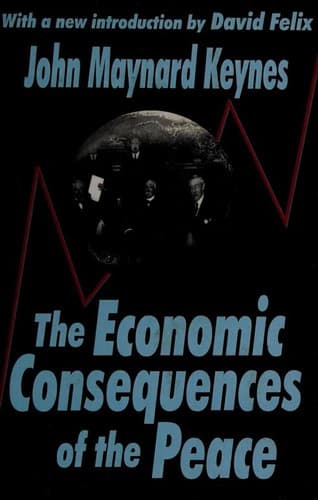
The Economic Consequences of the PeaceKeynes, John Maynard
History
The Economic Consequences of the Peace
Keynes, John Maynard
Economic history -- 1918-1945; Treaty of Versailles (1919 June 28); World War, 1914-1918 -- Economic aspects
The impulse which, we are told, is now strong in the mind of the United
States to be quit of the turmoil, the complication, the violence, the
expense, and, above all, the unintelligibility of the European problems,
is easily understood. No one can feel more intensely than the writer
how natural it is to retort to the folly and impracticability of the
European statesmen,--Rot, then, in your own malice, and we will go our
way--
Remote from Europe; from her blasted hopes;
Her fields of carnage, and polluted air.
But if America recalls for a moment what Europe has meant to her and
still means to her, what Europe, the mother of art and of knowledge, in
spite of everything, still is and still will be, will she not reject
these counsels of indifference and isolation, and interest herself in
what may prove decisive issues for the progress and civilization of all
mankind?
Assuming then, if only to keep our hopes up, that America will be
prepared to contribute to the process of building up the good forces of
Europe, and will not, having completed the destruction of an enemy,
leave us to our misfortunes,--what form should her aid take?
I do not propose to enter on details. But the main outlines of all
schemes for an international loan are much the same, The countries in a
position to lend assistance, the neutrals, the United Kingdom, and, for
the greater portion of the sum required, the United States, must provide
foreign purchasing credits for all the belligerent countries of
continental Europe, allied and ex-enemy alike. The aggregate sum
required might not be so large as is sometimes supposed. Much might be
done, perhaps, with a fund of $1,000,000,000 in the first instance. This
sum, even if a precedent of a different kind had been established by the
cancellation of Inter-Ally War Debt, should be lent and should be
borrowed with the unequivocal intention of its being repaid in full.
With this object in view, the security for the loan should be the best
obtainable, and the arrangements for its ultimate repayment as complete
as possible. In particular, it should rank, both for payment of interest
and discharge of capital, in front of all Reparation claims, all
Inter-Ally War Debt, all internal war loans, and all other Government
indebtedness of any other kind. Those borrowing countries who will be
entitled to Reparation payments should be required to pledge all such
receipts to repayment of the new loan. And all the borrowing countries
should be required to place their customs duties on a gold basis and to
pledge such receipts to its service.
Expenditure out of the loan should be subject to general, but not
detailed, supervision by the lending countries.
Public-domain text, read in full here on John Shaqi.
Reviews
Reviews
No reviews yet
Be the first to share your thoughts on this work.
Elsewhere in the archive
Join the Discussion
Join the discussion
Sign in to leave a comment or review.
Sign InorCreate an account