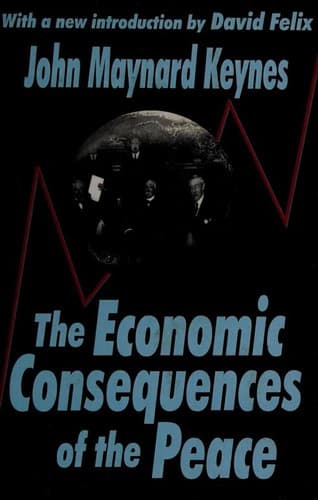
The Economic Consequences of the PeaceKeynes, John Maynard
History
The Economic Consequences of the Peace
Keynes, John Maynard
Economic history -- 1918-1945; Treaty of Versailles (1919 June 28); World War, 1914-1918 -- Economic aspects
The same conflict of purpose is apparent in the attitude of the Council
of the Allies at Paris towards the present Government of Germany. A
victory of Spartacism in Germany might well be the prelude to Revolution
everywhere: it would renew the forces of Bolshevism in Russia, and
precipitate the dreaded union of Germany and Russia; it would certainly
put an end to any expectations which have been built on the financial
and economic clauses of the Treaty of Peace. Therefore Paris does not
love Spartacus. But, on the other hand, a victory of reaction in Germany
would be regarded by every one as a threat to the security of Europe,
and as endangering the fruits of victory and the basis of the Peace.
Besides, a new military power establishing itself in the East, with its
spiritual home in Brandenburg, drawing to itself all the military talent
and all the military adventurers, all those who regret emperors and hate
democracy, in the whole of Eastern and Central and South-Eastern Europe,
a power which would be geographically inaccessible to the military
forces of the Allies, might well found, at least in the anticipations of
the timid, a new Napoleonic domination, rising, as a phoenix, from the
ashes of cosmopolitan militarism. So Paris dare not love Brandenburg.
The argument points, then, to the sustentation of those moderate forces
of order, which, somewhat to the world's surprise, still manage to
maintain themselves on the rock of the German character. But the present
Government of Germany stands for German unity more perhaps than for
anything else; the signature of the Peace was, above all, the price
which some Germans thought it worth while to pay for the unity which was
all that was left them of 1870. Therefore Paris, with some hopes of
disintegration across the Rhine not yet extinguished, can resist no
opportunity of insult or indignity, no occasion of lowering the
prestige or weakening the influence of a Government, with the continued
stability of which all the conservative interests of Europe are
nevertheless bound up.
The same dilemma affects the future of Poland in the rÙle which France
has cast for her. She is to be strong, Catholic, militarist, and
faithful, the consort, or at least the favorite, of victorious France,
prosperous and magnificent between the ashes of Russia and the ruin of
Germany. Roumania, if only she could be persuaded to keep up appearances
a little more, is a part of the same scatter-brained conception. Yet,
unless her great neighbors are prosperous and orderly, Poland is an
economic impossibility with no industry but Jew-baiting. And when Poland
finds that the seductive policy of France is pure rhodomontade and that
there is no money in it whatever, nor glory either, she will fall, as
promptly as possible, into the arms of somebody else.
Public-domain text, read in full here on John Shaqi.
Reviews
Reviews
No reviews yet
Be the first to share your thoughts on this work.
Elsewhere in the archive
Join the Discussion
Join the discussion
Sign in to leave a comment or review.
Sign InorCreate an account