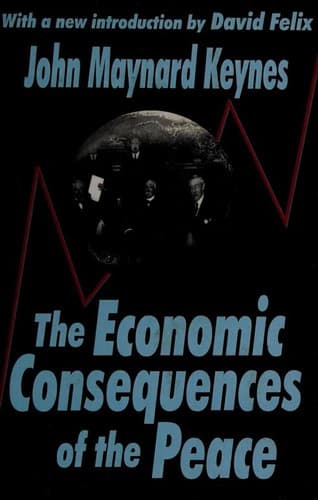
The Economic Consequences of the PeaceKeynes, John Maynard
History
The Economic Consequences of the Peace
Keynes, John Maynard
Economic history -- 1918-1945; Treaty of Versailles (1919 June 28); World War, 1914-1918 -- Economic aspects
The calculations of "diplomacy" lead us, therefore, nowhere. Crazy
dreams and childish intrigue in Russia and Poland and thereabouts are
the favorite indulgence at present of those Englishmen and Frenchmen who
seek excitement in its least innocent form, and believe, or at least
behave as if foreign policy was of the same _genre_ as a cheap
melodrama.
Let us turn, therefore, to something more solid. The German Government
has announced (October 30, 1919) its continued adhesion to a policy of
non-intervention in the internal affairs of Russia, "not only on
principle, but because it believes that this policy is also justified
from a practical point of view." Let us assume that at last we also
adopt the same standpoint, if not on principle, at least from a
practical point of view. What are then the fundamental economic factors
in the future relations of Central to Eastern Europe?
Before the war Western and Central Europe drew from Russia a substantial
part of their imported cereals. Without Russia the importing countries
would have had to go short. Since 1914 the loss of the Russian supplies
has been made good, partly by drawing on reserves, partly from the
bumper harvests of North America called forth by Mr. Hoover's guaranteed
price, but largely by economies of consumption and by privation. After
1920 the need of Russian supplies will be even greater than it was
before the war; for the guaranteed price in North America will have been
discontinued, the normal increase of population there will, as compared
with 1914, have swollen the home demand appreciably, and the soil of
Europe will not yet have recovered its former productivity. If trade is
not resumed with Russia, wheat in 1920-21 (unless the seasons are
specially bountiful) must be scarce and very dear. The blockade of
Russia, lately proclaimed by the Allies, is therefore a foolish and
short-sighted proceeding; we are blockading not so much Russia as
ourselves.
The process of reviving the Russian export trade is bound in any case to
be a slow one. The present productivity of the Russian peasant is not
believed to be sufficient to yield an exportable surplus on the pre-war
scale. The reasons for this are obviously many, but amongst them are
included the insufficiency of agricultural implements and accessories
and the absence of incentive to production caused by the lack of
commodities in the towns which the peasants can purchase in exchange for
their produce. Finally, there is the decay of the transport system,
which hinders or renders impossible the collection of local surpluses in
the big centers of distribution.
Public-domain text, read in full here on John Shaqi.
Reviews
Reviews
No reviews yet
Be the first to share your thoughts on this work.
Elsewhere in the archive
Join the Discussion
Join the discussion
Sign in to leave a comment or review.
Sign InorCreate an account