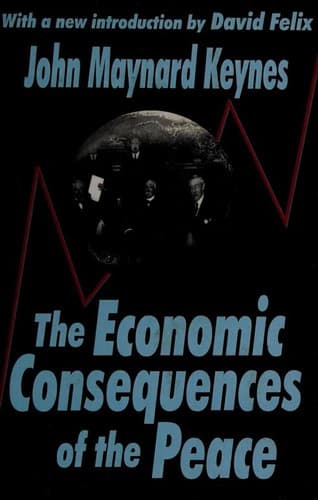
The Economic Consequences of the PeaceKeynes, John Maynard
History
The Economic Consequences of the Peace
Keynes, John Maynard
Economic history -- 1918-1945; Treaty of Versailles (1919 June 28); World War, 1914-1918 -- Economic aspects
I see few signs of sudden or dramatic developments anywhere. Riots and
revolutions there may be, but not such, at present, as to have
fundamental significance. Against political tyranny and injustice
Revolution is a weapon. But what counsels of hope can Revolution offer
to sufferers from economic privation, which does not arise out of the
injustices of distribution but is general? The only safeguard against
Revolution in Central Europe is indeed the fact that, even to the minds
of men who are desperate, Revolution offers no prospect of improvement
whatever. There may, therefore, be ahead of us a long, silent process of
semi-starvation, and of a gradual, steady lowering of the standards of
life and comfort. The bankruptcy and decay of Europe, if we allow it to
proceed, will affect every one in the long-run, but perhaps not in a way
that is striking or immediate.
This has one fortunate side. We may still have time to reconsider our
courses and to view the world with new eyes. For the immediate future
events are taking charge, and the near destiny of Europe is no longer in
the hands of any man. The events of the coming year will not be shaped
by the deliberate acts of statesmen, but by the hidden currents, flowing
continually beneath the surface of political history, of which no one
can predict the outcome. In one way only can we influence these hidden
currents,--by setting in motion those forces of instruction and
imagination which change _opinion_. The assertion of truth, the
unveiling of illusion, the dissipation of hate, the enlargement and
instruction of men's hearts and minds, must be the means.
In this autumn of 1919, in which I write, we are at the dead season of
our fortunes. The reaction from the exertions, the fears, and the
sufferings of the past five years is at its height. Our power of feeling
or caring beyond the immediate questions of our own material well-being
is temporarily eclipsed. The greatest events outside our own direct
experience and the most dreadful anticipations cannot move us.
In each human heart terror survives
The ruin it has gorged: the loftiest fear
All that they would disdain to think were true:
Hypocrisy and custom make their minds
The fanes of many a worship, now outworn.
They dare not devise good for man's estate,
And yet they know not that they do not dare.
The good want power but to weep barren tears.
The powerful goodness want: worse need for them.
The wise want love; and those who love want wisdom;
And all best things are thus confused to ill.
Many are strong and rich, and would be just,
But live among their suffering fellow-men
As if none felt: they know not what they do.
We have been moved already beyond endurance, and need rest. Never in the
lifetime of men now living has the universal element in the soul of man
burnt so dimly.
Public-domain text, read in full here on John Shaqi.
Reviews
Reviews
No reviews yet
Be the first to share your thoughts on this work.
Elsewhere in the archive
Join the Discussion
Join the discussion
Sign in to leave a comment or review.
Sign InorCreate an account