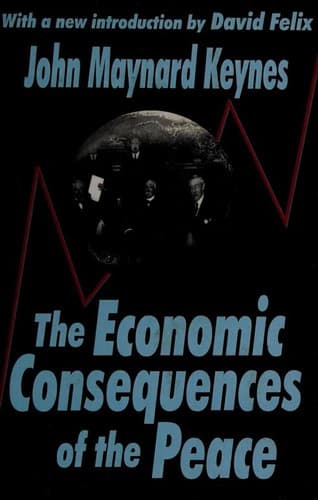
The Economic Consequences of the PeaceKeynes, John Maynard
History
The Economic Consequences of the Peace
Keynes, John Maynard
Economic history -- 1918-1945; Treaty of Versailles (1919 June 28); World War, 1914-1918 -- Economic aspects
For these reasons the true voice of the new generation has not yet
spoken, and silent opinion is not yet formed. To the formation of the
general opinion of the future I dedicate this book.
THE END
FOOTNOTES:
[157] The figures for the United Kingdom are as follows:
Net Excess of
Monthly Imports Exports Imports
Average $1,000 $1,000 $1,000
1913 274,650 218,850 55,800
1914 250,485 179,465 71,020
Jan.-Mar. 1919 547,890 245,610 302,280
April-June 1919 557,015 312,315 244,700
July-Sept. 1919 679,635 344,315 335,320
But this excess is by no means so serious as it looks; for with the
present high freight earnings of the mercantile marine the various
"invisible" exports of the United Kingdom are probably even higher than
they were before the war, and may average at least $225,000,000 monthly.
[158] President Wilson was mistaken in suggesting that the
supervision of Reparation payments has been entrusted to the League of
Nations. As I pointed out in Chapter V., whereas the League is invoked
in regard to most of the continuing economic and territorial provisions
of the Treaty, this is not the case as regards Reparation, over the
problems and modifications of which the Reparation Commission is supreme
without appeal of any kind to the League of Nations.
[159] These Articles, which provide safeguards against the
outbreak of war between members of the League and also between members
and non-members, are the solid achievement of the Covenant. These
Articles make substantially less probable a war between organized Great
Powers such as that of 1914. This alone should commend the League to all
men.
[160] It would be expedient so to define a "protectionist
tariff" as to permit (_a_) the total prohibition of certain imports;
(_b_) the imposition of sumptuary or revenue customs duties on
commodities not produced at home; (_c_) the imposition of customs duties
which did not exceed by more than five per cent a countervailing excise
on similar commodities produced at home; (_d_) export duties. Further,
special exceptions might be permitted by a majority vote of the
countries entering the Union. Duties which had existed for five years
prior to a country's entering the Union might be allowed to disappear
gradually by equal instalments spread over the five years subsequent to
joining the Union.
Public-domain text, read in full here on John Shaqi.
Reviews
Reviews
No reviews yet
Be the first to share your thoughts on this work.
Elsewhere in the archive
Join the Discussion
Join the discussion
Sign in to leave a comment or review.
Sign InorCreate an account