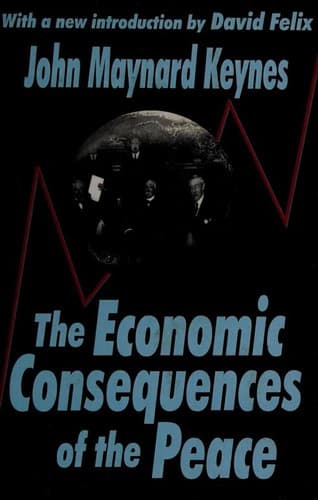
The Economic Consequences of the Peace — John Shaqi
The Economic Consequences of the PeaceKeynes, John Maynard
History
The Economic Consequences of the Peace
Keynes, John Maynard
Economic history -- 1918-1945; Treaty of Versailles (1919 June 28); World War, 1914-1918 -- Economic aspects
In England the outward aspect of life does not yet teach us to feel or
realize in the least that an age is over. We are busy picking up the
threads of our life where we dropped them, with this difference only,
that many of us seem a good deal richer than we were before. Where we
spent millions before the war, we have now learnt that we can spend
hundreds of millions and apparently not suffer for it. Evidently we did
not exploit to the utmost the possibilities of our economic life. We
look, therefore, not only to a return to the comforts of 1914, but to an
immense broadening and intensification of them. All classes alike thus
build their plans, the rich to spend more and save less, the poor to
spend more and work less.
But perhaps it is only in England (and America) that it is possible to
be so unconscious. In continental Europe the earth heaves and no one but
is aware of the rumblings. There it is not just a matter of extravagance
or "labor troubles"; but of life and death, of starvation and existence,
and of the fearful convulsions of a dying civilization.
* * * * *
For one who spent in Paris the greater part of the six months which
succeeded the Armistice an occasional visit to London was a strange
experience. England still stands outside Europe. Europe's voiceless
tremors do not reach her. Europe is apart and England is not of her
flesh and body. But Europe is solid with herself. France, Germany,
Italy, Austria and Holland, Russia and Roumania and Poland, throb
together, and their structure and civilization are essentially one. They
flourished together, they have rocked together in a war, which we, in
spite of our enormous contributions and sacrifices (like though in a
less degree than America), economically stood outside, and they may fall
together. In this lies the destructive significance of the Peace of
Paris. If the European Civil War is to end with France and Italy abusing
their momentary victorious power to destroy Germany and Austria-Hungary
now prostrate, they invite their own destruction also, being so deeply
and inextricably intertwined with their victims by hidden psychic and
economic bonds. At any rate an Englishman who took part in the
Conference of Paris and was during those months a member of the Supreme
Economic Council of the Allied Powers, was bound to become, for him a
new experience, a European in his cares and outlook. There, at the nerve
center of the European system, his British preoccupations must largely
fall away and he must be haunted by other and more dreadful specters.
Paris was a nightmare, and every one there was morbid. A sense of
impending catastrophe overhung the frivolous scene; the futility and
smallness of man before the great events confronting him; the mingled
significance and unreality of the decisions; levity, blindness,
insolence, confused cries from without,--all the elements of ancient
tragedy were there. Seated indeed amid the theatrical trappings of the
Public-domain text, read in full here on John Shaqi.
Reviews
Reviews
No reviews yet
Be the first to share your thoughts on this work.
Join the Discussion
Join the discussion
Sign in to leave a comment or review.
Sign InorCreate an account