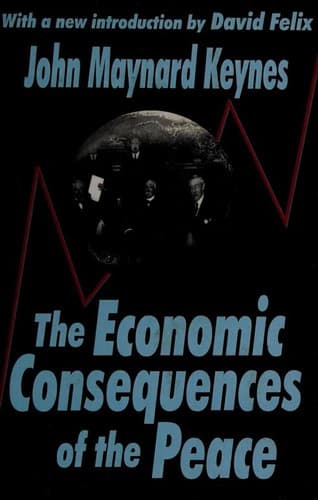
The Economic Consequences of the PeaceKeynes, John Maynard
History
The Economic Consequences of the Peace
Keynes, John Maynard
Economic history -- 1918-1945; Treaty of Versailles (1919 June 28); World War, 1914-1918 -- Economic aspects
We had indeed quite a wrong idea of the President. We knew him to be
solitary and aloof, and believed him very strong-willed and obstinate.
We did not figure him as a man of detail, but the clearness with which
he had taken hold of certain main ideas would, we thought, in
combination with his tenacity, enable him to sweep through cobwebs.
Besides these qualities he would have the objectivity, the cultivation,
and the wide knowledge of the student. The great distinction of language
which had marked his famous Notes seemed to indicate a man of lofty and
powerful imagination. His portraits indicated a fine presence and a
commanding delivery. With all this he had attained and held with
increasing authority the first position in a country where the arts of
the politician are not neglected. All of which, without expecting the
impossible, seemed a fine combination of qualities for the matter in
hand.
The first impression of Mr. Wilson at close quarters was to impair some
but not all of these illusions. His head and features were finely cut
and exactly like his photographs, and the muscles of his neck and the
carriage of his head were distinguished. But, like Odysseus, the
President looked wiser when he was seated; and his hands, though capable
and fairly strong, were wanting in sensitiveness and finesse. The first
glance at the President suggested not only that, whatever else he might
be, his temperament was not primarily that of the student or the
scholar, but that he had not much even of that culture of the world
which marks M. Clemenceau and Mr. Balfour as exquisitely cultivated
gentlemen of their class and generation. But more serious than this, he
was not only insensitive to his surroundings in the external sense, he
was not sensitive to his environment at all. What chance could such a
man have against Mr. Lloyd George's unerring, almost medium-like,
sensibility to every one immediately round him? To see the British Prime
Minister watching the company, with six or seven senses not available to
ordinary men, judging character, motive, and subconscious impulse,
perceiving what each was thinking and even what each was going to say
next, and compounding with telepathic instinct the argument or appeal
best suited to the vanity, weakness, or self-interest of his immediate
auditor, was to realize that the poor President would be playing blind
man's buff in that party. Never could a man have stepped into the parlor
a more perfect and predestined victim to the finished accomplishments of
the Prime Minister. The Old World was tough in wickedness anyhow; the
Old World's heart of stone might blunt the sharpest blade of the bravest
knight-errant. But this blind and deaf Don Quixote was entering a cavern
where the swift and glittering blade was in the hands of the adversary.
Public-domain text, read in full here on John Shaqi.
Reviews
Reviews
No reviews yet
Be the first to share your thoughts on this work.
Join the Discussion
Join the discussion
Sign in to leave a comment or review.
Sign InorCreate an account