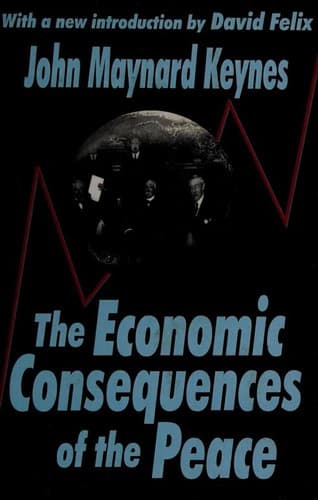
The Economic Consequences of the Peace — John Shaqi
The Economic Consequences of the PeaceKeynes, John Maynard
History
The Economic Consequences of the Peace
Keynes, John Maynard
Economic history -- 1918-1945; Treaty of Versailles (1919 June 28); World War, 1914-1918 -- Economic aspects
He not only had no proposals in detail, but he was in many respects,
perhaps inevitably, ill-informed as to European conditions. And not only
was he ill-informed--that was true of Mr. Lloyd George also--but his
mind was slow and unadaptable. The President's slowness amongst the
Europeans was noteworthy. He could not, all in a minute, take in what
the rest were saying, size up the situation with a glance, frame a
reply, and meet the case by a slight change of ground; and he was
liable, therefore, to defeat by the mere swiftness, apprehension, and
agility of a Lloyd George. There can seldom have been a statesman of the
first rank more incompetent than the President in the agilities of the
council chamber. A moment often arrives when substantial victory is
yours if by some slight appearance of a concession you can save the face
of the opposition or conciliate them by a restatement of your proposal
helpful to them and not injurious to anything essential to yourself. The
President was not equipped with this simple and usual artfulness. His
mind was too slow and unresourceful to be ready with _any_ alternatives.
The President was capable of digging his toes in and refusing to budge,
as he did over Fiume. But he had no other mode of defense, and it needed
as a rule but little manoeuvering by his opponents to prevent matters
from coming to such a head until it was too late. By pleasantness and an
appearance of conciliation, the President would be manoeuvered off his
ground, would miss the moment for digging his toes in, and, before he
knew where he had been got to, it was too late. Besides, it is
impossible month after month in intimate and ostensibly friendly
converse between close associates, to be digging the toes in all the
time. Victory would only have been possible to one who had always a
sufficiently lively apprehension of the position as a whole to reserve
his fire and know for certain the rare exact moments for decisive
action. And for that the President was far too slow-minded and
bewildered.
Public-domain text, read in full here on John Shaqi.
Reviews
Reviews
No reviews yet
Be the first to share your thoughts on this work.
Join the Discussion
Join the discussion
Sign in to leave a comment or review.
Sign InorCreate an account