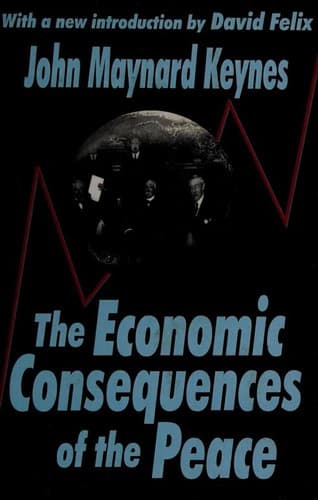
The Economic Consequences of the PeaceKeynes, John Maynard
History
The Economic Consequences of the Peace
Keynes, John Maynard
Economic history -- 1918-1945; Treaty of Versailles (1919 June 28); World War, 1914-1918 -- Economic aspects
After a display of much principle and dignity in the early days of the
Council of Ten, he discovered that there were certain very important
points in the program of his French, British, or Italian colleague, as
the case might be, of which he was incapable of securing the surrender
by the methods of secret diplomacy. What then was he to do in the last
resort? He could let the Conference drag on an endless length by the
exercise of sheer obstinacy. He could break it up and return to America
in a rage with nothing settled. Or he could attempt an appeal to the
world over the heads of the Conference. These were wretched
alternatives, against each of which a great deal could be said. They
were also very risky,--especially for a politician. The President's
mistaken policy over the Congressional election had weakened his
personal position in his own country, and it was by no means certain
that the American public would support him in a position of
intransigeancy. It would mean a campaign in which the issues would be
clouded by every sort of personal and party consideration, and who could
say if right would triumph in a struggle which would certainly not be
decided on its merits? Besides, any open rupture with his colleagues
would certainly bring upon his head the blind passions of "anti-German"
resentment with which the public of all allied countries were still
inspired. They would not listen to his arguments. They would not be cool
enough to treat the issue as one of international morality or of the
right governance of Europe. The cry would simply be that, for various
sinister and selfish reasons, the President wished "to let the Hun off."
The almost unanimous voice of the French and British Press could be
anticipated. Thus, if he threw down the gage publicly he might be
defeated. And if he were defeated, would not the final Peace be far
worse than if he were to retain his prestige and endeavor to make it as
good as the limiting conditions of European politics would allow, him?
But above all, if he were defeated, would he not lose the League of
Nations? And was not this, after all, by far the most important issue
for the future happiness of the world? The Treaty would be altered and
softened by time. Much in it which now seemed so vital would become
trifling, and much which was impracticable would for that very reason
never happen. But the League, even in an imperfect form, was permanent;
it was the first commencement of a new principle in the government of
the world; Truth and Justice in international relations could not be
established in a few months,--they must be born in due course by the
slow gestation of the League. Clemenceau had been clever enough to let
it be seen that he would swallow the League at a price.
Public-domain text, read in full here on John Shaqi.
Reviews
Reviews
No reviews yet
Be the first to share your thoughts on this work.
Join the Discussion
Join the discussion
Sign in to leave a comment or review.
Sign InorCreate an account