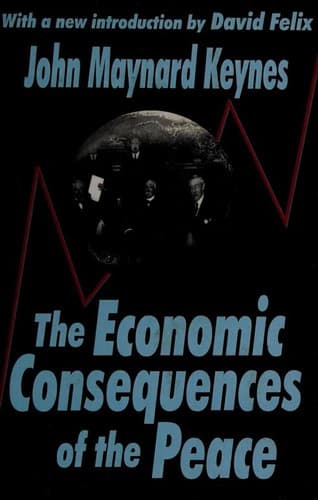
The Economic Consequences of the PeaceKeynes, John Maynard
History
The Economic Consequences of the Peace
Keynes, John Maynard
Economic history -- 1918-1945; Treaty of Versailles (1919 June 28); World War, 1914-1918 -- Economic aspects
Lest the Reparation Commission fail by ignorance to exercise its rights
to the full, it is further provided that the German Government shall
communicate to it within six months of the Treaty's coming into force a
list of all the rights and interests in question, "whether already
granted, contingent or not yet exercised," and any which are not so
communicated within this period will automatically lapse in favor of the
Allied Governments.[27] How far an edict of this character can be made
binding on a German national, whose person and property lie outside the
jurisdiction of his own Government, is an unsettled question; but all
the countries specified in the above list are open to pressure by the
Allied authorities, whether by the imposition of an appropriate Treaty
clause or otherwise.
(_c_) There remains a third provision more sweeping than either of the
above, neither of which affects German interests in _neutral_
countries. The Reparation Commission is empowered up to May 1, 1921, to
demand payment up to $5,000,000,000 _in such manner as they may fix_,
"whether in gold, commodities, ships, securities or otherwise."[28] This
provision has the effect of intrusting to the Reparation Commission for
the period in question dictatorial powers over all German property of
every description whatever. They can, under this Article, point to any
specific business, enterprise, or property, whether within or outside
Germany, and demand its surrender; and their authority would appear to
extend not only to property existing at the date of the Peace, but also
to any which may be created or acquired at any time in the course of the
next eighteen months. For example, they could pick out--as presumably
they will as soon as they are established--the fine and powerful German
enterprise in South America known as the _Deutsche Ueberseeische
Elektrizit‰tsgesellschaft_ (the D.U.E.G.), and dispose of it to Allied
interests. The clause is unequivocal and all-embracing. It is worth
while to note in passing that it introduces a quite novel principle in
the collection of indemnities. Hitherto, a sum has been fixed, and the
nation mulcted has been left free to devise and select for itself the
means of payment. But in this case the payees can (for a certain
period) not only demand a certain sum but specify the particular kind of
property in which payment is to be effected. Thus the powers of the
Reparation Commission, with which I deal more particularly in the next
chapter, can be employed to destroy Germany's commercial and economic
organization as well as to exact payment.
Public-domain text, read in full here on John Shaqi.
Reviews
Reviews
No reviews yet
Be the first to share your thoughts on this work.
Join the Discussion
Join the discussion
Sign in to leave a comment or review.
Sign InorCreate an account