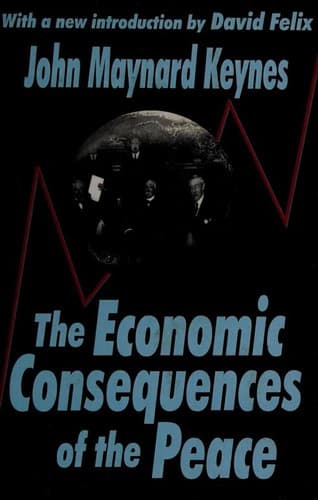
The Economic Consequences of the PeaceKeynes, John Maynard
History
The Economic Consequences of the Peace
Keynes, John Maynard
Economic history -- 1918-1945; Treaty of Versailles (1919 June 28); World War, 1914-1918 -- Economic aspects
The pre-war figure of 118,000,000 tons net (_i.e._ after allowing for
loss of territory and consumption at the mines) is likely to fall,
therefore, at least as low as to 100,000,000[45] tons, having regard to
the above factors. If 40,000,000 tons of this are to be exported to the
Allies, there remain 60,000,000 tons for Germany herself to meet her own
domestic consumption. Demand as well as supply will be diminished by
loss of territory, but at the most extravagant estimate this could not
be put above 29,000,000 tons.[46] Our hypothetical calculations,
therefore, leave us with post-war German domestic requirements, on the
basis of a pre-war efficiency of railways and industry, of 110,000,000
tons against an output not exceeding 100,000,000 tons, of which
40,000,000 tons are mortgaged to the Allies.
The importance of the subject has led me into a somewhat lengthy
statistical analysis. It is evident that too much significance must not
be attached to the precise figures arrived at, which are hypothetical
and dubious.[47] But the general character of the facts presents itself
irresistibly. Allowing for the loss of territory and the loss of
efficiency, Germany cannot export coal in the near future (and will even
be dependent on her Treaty rights to purchase in Upper Silesia), if she
is to continue as an industrial nation. Every million tons she is forced
to export must be at the expense of closing down an industry. With
results to be considered later this within certain limits is _possible_.
But it is evident that Germany cannot and will not furnish the Allies
with a contribution of 40,000,000 tons annually. Those Allied Ministers,
who have told their peoples that she can, have certainly deceived them
for the sake of allaying for the moment the misgivings of the European
peoples as to the path along which they are being led.
The presence of these illusory provisions (amongst others) in the
clauses of the Treaty of Peace is especially charged with danger for
the future. The more extravagant expectations as to Reparation
receipts, by which Finance Ministers have deceived their publics, will
be heard of no more when they have served their immediate purpose of
postponing the hour of taxation and retrenchment. But the coal clauses
will not be lost sight of so easily,--for the reason that it will be
absolutely vital in the interests of France and Italy that these
countries should do everything in their power to exact their bond. As a
result of the diminished output due to German destruction in France, of
the diminished output of mines in the United Kingdom and elsewhere, and
of many secondary causes, such as the breakdown of transport and of
organization and the inefficiency of new governments, the coal position
of all Europe is nearly desperate;[48] and France and Italy, entering
the scramble with certain Treaty rights, will not lightly surrender
them.
Public-domain text, read in full here on John Shaqi.
Reviews
Reviews
No reviews yet
Be the first to share your thoughts on this work.
Join the Discussion
Join the discussion
Sign in to leave a comment or review.
Sign InorCreate an account