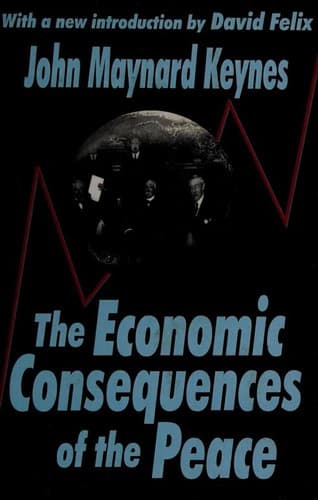
The Economic Consequences of the PeaceKeynes, John Maynard
History
The Economic Consequences of the Peace
Keynes, John Maynard
Economic history -- 1918-1945; Treaty of Versailles (1919 June 28); World War, 1914-1918 -- Economic aspects
I do not believe that, at the date of the Armistice, responsible
authorities in the Allied countries expected any indemnity from Germany
beyond the cost of reparation for the direct material damage which had
resulted from the invasion of Allied territory and from the submarine
campaign. At that time there were serious doubts as to whether Germany
intended to accept our terms, which in other respects were inevitably
very severe, and it would have been thought an unstatesmanlike act to
risk a continuance of the war by demanding a money payment which Allied
opinion was not then anticipating and which probably could not be
secured in any case. The French, I think, never quite accepted this
point of view; but it was certainly the British attitude; and in this
atmosphere the pre-Armistice conditions were framed.
A month later the atmosphere had changed completely. We had discovered
how hopeless the German position really was, a discovery which some,
though not all, had anticipated, but which no one had dared reckon on as
a certainty. It was evident that we could have secured unconditional
surrender if we had determined to get it.
But there was another new factor in the situation which was of greater
local importance. The British Prime Minister had perceived that the
conclusion of hostilities might soon bring with it the break-up of the
political _bloc_ upon which he was depending for his personal
ascendency, and that the domestic difficulties which would be attendant
on demobilization, the turn-over of industry from war to peace
conditions, the financial situation, and the general psychological
reactions of men's minds, would provide his enemies with powerful
weapons, if he were to leave them time to mature. The best chance,
therefore, of consolidating his power, which was personal and exercised,
as such, independently of party or principle, to an extent unusual in
British politics, evidently lay in active hostilities before the
prestige of victory had abated, and in an attempt to found on the
emotions of the moment a new basis of power which might outlast the
inevitable reactions of the near future. Within a brief period,
therefore, after the Armistice, the popular victor, at the height of his
influence and his authority, decreed a General Election. It was widely
recognized at the time as an act of political immorality. There were no
grounds of public interest which did not call for a short delay until
the issues of the new age had a little defined themselves and until the
country had something more specific before it on which to declare its
mind and to instruct its new representatives. But the claims of private
ambition determined otherwise.
Public-domain text, read in full here on John Shaqi.
Reviews
Reviews
No reviews yet
Be the first to share your thoughts on this work.
Elsewhere in the archive
Join the Discussion
Join the discussion
Sign in to leave a comment or review.
Sign InorCreate an account