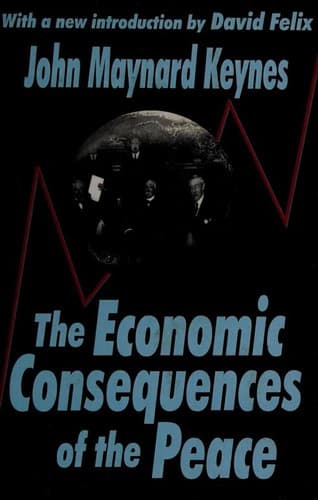
The Economic Consequences of the PeaceKeynes, John Maynard
History
The Economic Consequences of the Peace
Keynes, John Maynard
Economic history -- 1918-1945; Treaty of Versailles (1919 June 28); World War, 1914-1918 -- Economic aspects
Here is food for the cynic. To this concoction of greed and sentiment,
prejudice and deception, three weeks of the platform had reduced the
powerful governors of England, who but a little while before had spoken
not ignobly of Disarmament and a League of Nations and of a just and
lasting peace which should establish the foundations of a new Europe.
On the same evening the Prime Minister at Bristol withdrew in effect his
previous reservations and laid down four principles to govern his
Indemnity Policy, of which the chief were: First, we have an absolute
right to demand the whole cost of the war; second, we propose to demand
the whole cost of the war; and third, a Committee appointed by direction
of the Cabinet believe that it can be done.[100] Four days later he went
to the polls.
The Prime Minister never said that he himself believed that Germany
could pay the whole cost of the war. But the program became in the
mouths of his supporters on the hustings a great deal more than
concrete. The ordinary voter was led to believe that Germany could
certainly be made to pay the greater part, if not the whole cost of the
war. Those whose practical and selfish fears for the future the expenses
of the war had aroused, and those whose emotions its horrors had
disordered, were both provided for. A vote for a Coalition candidate
meant the Crucifixion of Anti-Christ and the assumption by Germany of
the British National Debt.
It proved an irresistible combination, and once more Mr. George's
political instinct was not at fault. No candidate could safely denounce
this program, and none did so. The old Liberal Party, having nothing
comparable to offer to the electorate, was swept out of existence.[101]
A new House of Commons came into being, a majority of whose members had
pledged themselves to a great deal more than the Prime Minister's
guarded promises. Shortly after their arrival at Westminster I asked a
Conservative friend, who had known previous Houses, what he thought of
them. "They are a lot of hard-faced men," he said, "who look as if they
had done very well out of the war."
This was the atmosphere in which the Prime Minister left for Paris, and
these the entanglements he had made for himself. He had pledged himself
and his Government to make demands of a helpless enemy inconsistent with
solemn engagements on our part, on the faith of which this enemy had
laid down his arms. There are few episodes in history which posterity
will have less reason to condone,--a war ostensibly waged in defense of
the sanctity of international engagements ending in a definite breach of
one of the most sacred possible of such engagements on the part of
victorious champions of these ideals.[102]
Public-domain text, read in full here on John Shaqi.
Reviews
Reviews
No reviews yet
Be the first to share your thoughts on this work.
Elsewhere in the archive
Join the Discussion
Join the discussion
Sign in to leave a comment or review.
Sign InorCreate an account