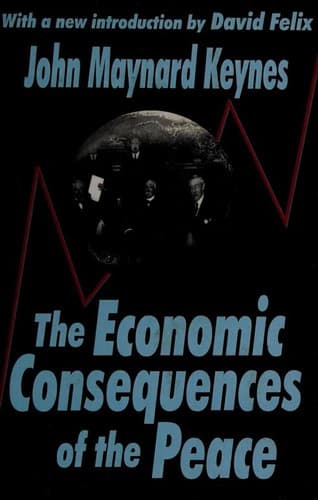
The Economic Consequences of the PeaceKeynes, John Maynard
History
The Economic Consequences of the Peace
Keynes, John Maynard
Economic history -- 1918-1945; Treaty of Versailles (1919 June 28); World War, 1914-1918 -- Economic aspects
I feel much more confidence in the approximate accuracy of the total
figure[107] than in its division between the different claimants. The
reader will observe that in any case the addition of Pensions and
Allowances enormously increases the aggregate claim, raising it indeed
by nearly double. Adding this figure to the estimate under other heads,
we have a total claim against Germany of $40,000,000,000.[108] I believe
that this figure is fully high enough, and that the actual result may
fall somewhat short of it.[109] In the next section of this chapter the
relation of this figure to Germany's capacity to pay will be examined.
It is only necessary here to remind the reader of certain other
particulars of the Treaty which speak for themselves:
1. Out of the total amount of the claim, whatever it eventually turns
out to be, a sum of $5,000,000,000 must be paid before May 1, 1921. The
possibility of this will be discussed below. But the Treaty itself
provides certain abatements. In the first place, this sum is to include
the expenses of the Armies of Occupation since the Armistice (a large
charge of the order of magnitude of $1,000,000,000 which under another
Article of the Treaty--No. 249--is laid upon Germany).[110] But further,
"such supplies of food and raw materials as may be judged by the
Governments of the Principal Allied and Associated Powers to be
essential to enable Germany to meet her obligations for Reparation may
also, with the approval of the said Governments, be paid for out of the
above sum."[111] This is a qualification of high importance. The clause,
as it is drafted, allows the Finance Ministers of the Allied countries
to hold out to their electorates the hope of substantial payments at an
early date, while at the same time it gives to the Reparation Commission
a discretion, which the force of facts will compel them to exercise, to
give back to Germany what is required for the maintenance of her
economic existence. This discretionary power renders the demand for an
immediate payment of $5,000,000,000 less injurious than it would
otherwise be, but nevertheless it does not render it innocuous. In the
first place, my conclusions in the next section of this chapter indicate
that this sum cannot be found within the period indicated, even if a
large proportion is in practice returned to Germany for the purpose of
enabling her to pay for imports. In the second place, the Reparation
Commission can only exercise its discretionary power effectively by
taking charge of the entire foreign trade of Germany, together with the
foreign exchange arising out of it, which will be quite beyond the
capacity of any such body. If the Reparation Commission makes any
serious attempt to administer the collection of this sum of
$5,000,000,000 and to authorize the return to Germany of a part it, the
trade of Central Europe will be strangled by bureaucratic regulation in
its most inefficient form.
Public-domain text, read in full here on John Shaqi.
Reviews
Reviews
No reviews yet
Be the first to share your thoughts on this work.
Elsewhere in the archive
Join the Discussion
Join the discussion
Sign in to leave a comment or review.
Sign InorCreate an account