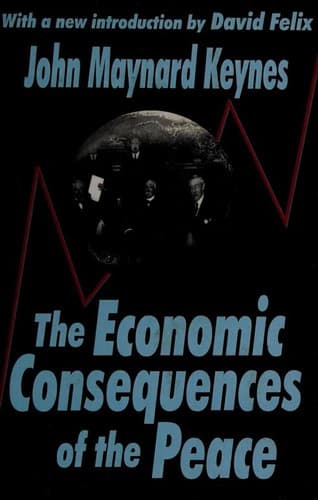
The Economic Consequences of the PeaceKeynes, John Maynard
History
The Economic Consequences of the Peace
Keynes, John Maynard
Economic history -- 1918-1945; Treaty of Versailles (1919 June 28); World War, 1914-1918 -- Economic aspects
6. This is not less the case because the Reparation Commission has been
given discretionary powers to vary the rate of interest, and to postpone
and even to cancel the capital indebtedness. In the first place, some of
these powers can only be exercised if the Commission or the Governments
represented on it are _unanimous_.[116] But also, which is perhaps more
important, it will be the _duty_ of the Reparation Commission, until
there has been a unanimous and far-reaching change of the policy which
the Treaty represents, to extract from Germany year after year the
maximum sum obtainable. There is a great difference between fixing a
definite sum, which though large is within Germany's capacity to pay and
yet to retain a little for herself, and fixing a sum far beyond her
capacity, which is then to be reduced at the discretion of a foreign
Commission acting with the object of obtaining each year the maximum
which the circumstances of that year permit. The first still leaves her
with some slight incentive for enterprise, energy, and hope. The latter
skins her alive year by year in perpetuity, and however skilfully and
discreetly the operation is performed, with whatever regard for not
killing the patient in the process, it would represent a policy which,
if it were really entertained and deliberately practised, the judgment
of men would soon pronounce to be one of the most outrageous acts of a
cruel victor in civilized history.
There are other functions and powers of high significance which the
Treaty accords to the Reparation Commission. But these will be most
conveniently dealt with in a separate section.
III. _Germany's Capacity to pay_
The forms in which Germany can discharge the sum which she has engaged
herself to pay are three in number--
1. Immediately transferable wealth in the form of gold, ships, and
foreign securities;
2. The value of property in ceded territory, or surrendered under the
Armistice;
3. Annual payments spread over a term of years, partly in cash and
partly in materials such as coal products, potash, and dyes.
There is excluded from the above the actual restitution of property
removed from territory occupied by the enemy, as, for example, Russian
gold, Belgian and French securities, cattle, machinery, and works of
art. In so far as the actual goods taken can be identified and restored,
they must clearly be returned to their rightful owners, and cannot be
brought into the general reparation pool. This is expressly provided for
in Article 238 of the Treaty.
1. _Immediately Transferable Wealth_
Public-domain text, read in full here on John Shaqi.
Reviews
Reviews
No reviews yet
Be the first to share your thoughts on this work.
Elsewhere in the archive
Join the Discussion
Join the discussion
Sign in to leave a comment or review.
Sign InorCreate an account