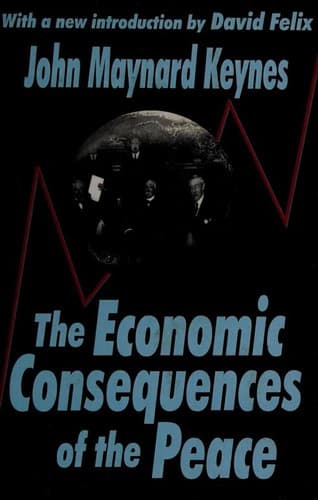
The Economic Consequences of the PeaceKeynes, John Maynard
History
The Economic Consequences of the Peace
Keynes, John Maynard
Economic history -- 1918-1945; Treaty of Versailles (1919 June 28); World War, 1914-1918 -- Economic aspects
(_a_) _Gold_.--After deduction of the gold to be returned to Russia, the
official holding of gold as shown in the Reichsbank's return of the 30th
November, 1918, amounted to $577,089,500. This was a very much larger
amount than had appeared in the Reichsbank's return prior to the
war,[117] and was the result of the vigorous campaign carried on in
Germany during the war for the surrender to the Reichsbank not only of
gold coin but of gold ornaments of every kind. Private hoards doubtless
still exist, but, in view of the great efforts already made, it is
unlikely that either the German Government or the Allies will be able to
unearth them. The return can therefore be taken as probably representing
the maximum amount which the German Government are able to extract from
their people. In addition to gold there was in the Reichsbank a sum of
about $5,000,000 in silver. There must be, however, a further
substantial amount in circulation, for the holdings of the Reichsbank
were as high as $45,500,000 on the 31st December, 1917, and stood at
about $30,000,000 up to the latter part of October, 1918, when the
internal run began on currency of every kind.[118] We may, therefore,
take a total of (say) $625,000,000 for gold and silver together at the
date of the Armistice.
These reserves, however, are no longer intact. During the long period
which elapsed between the Armistice and the Peace it became necessary
for the Allies to facilitate the provisioning of Germany from abroad.
The political condition of Germany at that time and the serious menace
of Spartacism rendered this step necessary in the interests of the
Allies themselves if they desired the continuance in Germany of a stable
Government to treat with. The question of how such provisions were to be
paid for presented, however, the gravest difficulties. A series of
Conferences was held at TrËves, at Spa, at Brussels, and subsequently at
Ch‚teau Villette and Versailles, between representatives of the Allies
and of Germany, with the object of finding some method of payment as
little injurious as possible to the future prospects of Reparation
payments. The German representatives maintained from the outset that the
financial exhaustion of their country was for the time being so complete
that a temporary loan from the Allies was the only possible expedient.
This the Allies could hardly admit at a time when they were preparing
demands for the immediate payment by Germany of immeasurably larger
sums. But, apart from this, the German claim could not be accepted as
strictly accurate so long as their gold was still untapped and their
remaining foreign securities unmarketed. In any case, it was out of the
question to suppose that in the spring of 1919 public opinion in the
Allied countries or in America would have allowed the grant of a
substantial loan to Germany. On the other hand, the Allies were
naturally reluctant to exhaust on the provisioning of Germany the gold
Public-domain text, read in full here on John Shaqi.
Reviews
Reviews
No reviews yet
Be the first to share your thoughts on this work.
Elsewhere in the archive
Join the Discussion
Join the discussion
Sign in to leave a comment or review.
Sign InorCreate an account