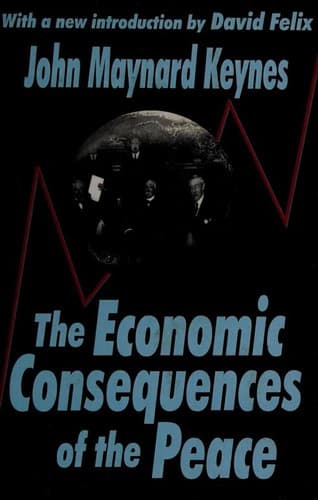
The Economic Consequences of the PeaceKeynes, John Maynard
History
The Economic Consequences of the Peace
Keynes, John Maynard
Economic history -- 1918-1945; Treaty of Versailles (1919 June 28); World War, 1914-1918 -- Economic aspects
(iii.) While Germany was not in a position to realize her foreign
investments during the war to the degree that we were, she did so
nevertheless in the case of certain countries and to the extent that
she was able. Before the United States came into the war, she is
believed to have resold a large part of the pick of her investments in
American securities, although some current estimates of these sales (a
figure of $300,000,000 has been mentioned) are probably exaggerated. But
throughout the war and particularly in its later stages, when her
exchanges were weak and her credit in the neighboring neutral countries
was becoming very low, she was disposing of such securities as Holland,
Switzerland, and Scandinavia would buy or would accept as collateral. It
is reasonably certain that by June, 1919, her investments in these
countries had been reduced to a negligible figure and were far exceeded
by her liabilities in them. Germany has also sold certain overseas
securities, such as Argentine cedulas, for which a market could be
found.
(iv.) It is certain that since the Armistice there has been a great
flight abroad of the foreign securities still remaining in private
hands. This is exceedingly difficult to prevent. German foreign
investments are as a rule in the form of bearer securities and are not
registered. They are easily smuggled abroad across Germany's extensive
land frontiers, and for some months before the conclusion of peace it
was certain that their owners would not be allowed to retain them if the
Allied Governments could discover any method of getting hold of them.
These factors combined to stimulate human ingenuity, and the efforts
both of the Allied and of the German Governments to interfere
effectively with the outflow are believed to have been largely futile.
In face of all these considerations, it will be a miracle if much
remains for Reparation. The countries of the Allies and of the United
States, the countries of Germany's own allies, and the neutral countries
adjacent to Germany exhaust between them almost the whole of the
civilized world; and, as we have seen, we cannot expect much to be
available for Reparation from investments in any of these quarters.
Indeed there remain no countries of importance for investments except
those of South America.
To convert the significance of these deductions into figures involves
much guesswork. I give the reader the best personal estimate I can form
after pondering the matter in the light of the available figures and
other relevant data.
I put the deduction under (i.) at $1,500,000,000, of which $500,000,000
may be ultimately available after meeting private debts, etc.
Public-domain text, read in full here on John Shaqi.
Reviews
Reviews
No reviews yet
Be the first to share your thoughts on this work.
Elsewhere in the archive
Join the Discussion
Join the discussion
Sign in to leave a comment or review.
Sign InorCreate an account