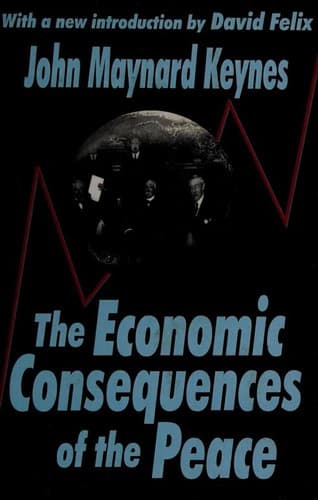
The Economic Consequences of the PeaceKeynes, John Maynard
History
The Economic Consequences of the Peace
Keynes, John Maynard
Economic history -- 1918-1945; Treaty of Versailles (1919 June 28); World War, 1914-1918 -- Economic aspects
(_b_) _Shipping_.--Germany has engaged, as we have seen above, to
surrender to the Allies virtually the whole of her merchant shipping. A
considerable part of it, indeed, was already in the hands of the Allies
prior to the conclusion of Peace, either by detention in their ports or
by the provisional transfer of tonnage under the Brussels Agreement in
connection with the supply of foodstuffs.[119] Estimating the tonnage of
German shipping to be taken over under the Treaty at 4,000,000 gross
tons, and the average value per ton at $150 per ton, the total money
value involved is $600,000,000.[120]
(_c_) _Foreign Securities_.--Prior to the census of foreign securities
carried out by the German Government in September, 1916,[121] of which
the exact results have not been made public, no official return of such
investments was ever called for in Germany, and the various unofficial
estimates are confessedly based on insufficient data, such as the
admission of foreign securities to the German Stock Exchanges, the
receipts of the stamp duties, consular reports, etc. The principal
German estimates current before the war are given in the appended
footnote.[122] This shows a general consensus of opinion among German
authorities that their net foreign investments were upwards of
$6,250,000,000. I take this figure as the basis of my calculations,
although I believe it to be an exaggeration; $5,000,000,000 would
probably be a safer figure.
Deductions from this aggregate total have to be made under four heads.
(i.) Investments in Allied countries and in the United States, which
between them constitute a considerable part of the world, have been
sequestrated by Public Trustees, Custodians of Enemy Property, and
similar officials, and are not available for Reparation except in so far
as they show a surplus over various private claims. Under the scheme for
dealing with enemy debts outlined in Chapter IV., the first charge on
these assets is the private claims of Allied against German nationals.
It is unlikely, except in the United States, that there will be any
appreciable surplus for any other purpose.
(ii.) Germany's most important fields of foreign investment before the
war were not, like ours, oversea, but in Russia, Austria-Hungary,
Turkey, Roumania, and Bulgaria. A great part of these has now become
almost valueless, at any rate for the time being; especially those in
Russia and Austria-Hungary. If present market value is to be taken as
the test, none of these investments are now saleable above a nominal
figure. Unless the Allies are prepared to take over these securities
much above their nominal market valuation, and hold them for future
realization, there is no substantial source of funds for immediate
payment in the form of investments in these countries.
Public-domain text, read in full here on John Shaqi.
Reviews
Reviews
No reviews yet
Be the first to share your thoughts on this work.
Elsewhere in the archive
Join the Discussion
Join the discussion
Sign in to leave a comment or review.
Sign InorCreate an account