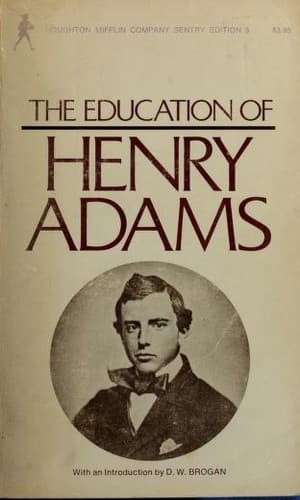
Adams, Henry, 1838-1918; Historians -- United States -- Biography
This was his whole diplomatic education, except that he found
rich veins of jealousy running between every chief and his staff. His
social education was more barren still, and more trying to his vanity.
His little mistakes in etiquette or address made him writhe with
torture. He never forgot the first two or three social functions he
attended: one an afternoon at Miss Burdett Coutts's in Stratton Place,
where he hid himself in the embrasure of a window and hoped that no one
noticed him; another was a garden-party given by the old anti-slavery
Duchess Dowager of Sutherland at Chiswick, where the American Minister
and Mrs. Adams were kept in conversation by the old Duchess till every
one else went away except the young Duke and his cousins, who set to
playing leap-frog on the lawn. At intervals during the next thirty
years Henry Adams continued to happen upon the Duke, who, singularly
enough, was always playing leap-frog. Still another nightmare he
suffered at a dance given by the old Duchess Dowager of Somerset, a
terrible vision in castanets, who seized him and forced him to perform
a Highland fling before the assembled nobility and gentry, with the
daughter of the Turkish Ambassador for partner. This might seem
humorous to some, but to him the world turned to ashes.
When the end of the season came, the private secretary had not
yet won a private acquaintance, and he hugged himself in his solitude
when the story of the battle of Bull Run appeared in the Times. He felt
only the wish to be more private than ever, for Bull Run was a worse
diplomatic than military disaster. All this is history and can be read
by public schools if they choose; but the curious and unexpected
happened to the Legation, for the effect of Bull Run on them was almost
strengthening. They no longer felt doubt. For the next year they went
on only from week to week, ready to leave England at once, and never
assuming more than three months for their limit. Europe was waiting to
see them go. So certain was the end that no one cared to hurry it.
So far as a private secretary could see, this was all that saved
his father. For many months he looked on himself as lost or finished in
the character of private secretary; and as about to begin, without
further experiment, a final education in the ranks of the Army of the
Potomac where he would find most of his friends enjoying a much
pleasanter life than his own. With this idea uppermost in his mind, he
passed the summer and the autumn, and began the winter. Any winter in
London is a severe trial; one's first winter is the most trying; but
the month of December, 1861, in Mansfield Street, Portland Place, would
have gorged a glutton of gloom.
Public-domain text, read in full here on John Shaqi.
Reviews
Reviews
No reviews yet
Be the first to share your thoughts on this work.
Elsewhere in the archive
Join the Discussion
Join the discussion
Sign in to leave a comment or review.
Sign InorCreate an account