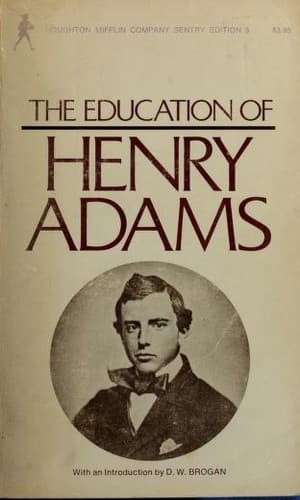
Adams, Henry, 1838-1918; Historians -- United States -- Biography
This is not a story of the diplomatic adventures of Charles
Francis Adams, but of his son Henry's adventures in search of an
education, which, if not taken too seriously, tended to humor. The
father's position in London was not altogether bad; the son's was
absurd. Thanks to certain family associations, Charles Francis Adams
naturally looked on all British Ministers as enemies; the only public
occupation of all Adamses for a hundred and fifty years at least, in
their brief intervals of quarrelling with State Street, had been to
quarrel with Downing Street; and the British Government, well used to a
liberal unpopularity abroad, even when officially rude liked to be
personally civil. All diplomatic agents are liable to be put, so to
speak, in a corner, and are none the worse for it. Minister Adams had
nothing in especial to complain of; his position was good while it
lasted, and he had only the chances of war to fear. The son had no such
compensations. Brought over in order to help his father, he could
conceive no way of rendering his father help, but he was clear that his
father had got to help him. To him, the Legation was social ostracism,
terrible beyond anything he had known. Entire solitude in the great
society of London was doubly desperate because his duties as private
secretary required him to know everybody and go with his father and
mother everywhere they needed escort. He had no friend, or even enemy,
to tell him to be patient. Had any one done it, he would surely have
broken out with the reply that patience was the last resource of fools
as well as of sages; if he was to help his father at all, he must do it
at once, for his father would never so much need help again. In fact he
never gave his father the smallest help, unless it were as a footman,
clerk, or a companion for the younger children.
He found himself in a singular situation for one who was to be
useful. As he came to see the situation closer, he began to doubt
whether secretaries were meant to be useful. Wars were too common in
diplomacy to disturb the habits of the diplomat. Most secretaries
detested their chiefs, and wished to be anything but useful. At the St.
James's Club, to which the Minister's son could go only as an invited
guest, the most instructive conversation he ever heard among the young
men of his own age who hung about the tables, more helpless than
himself, was: "Quel chien de pays!" or, "Que tu es beau aujourd'hui,
mon cher!" No one wanted to discuss affairs; still less to give or get
information. That was the affair of their chiefs, who were also slow to
assume work not specially ordered from their Courts. If the American
Minister was in trouble to-day, the Russian Ambassador was in trouble
yesterday, and the Frenchman would be in trouble to-morrow. It would
all come in the day's work. There was nothing professional in worry.
Empires were always tumbling to pieces and diplomats were always
picking them up.
Public-domain text, read in full here on John Shaqi.
Reviews
Reviews
No reviews yet
Be the first to share your thoughts on this work.
Elsewhere in the archive