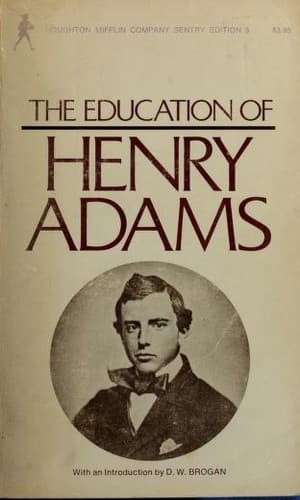
Adams, Henry, 1838-1918; Historians -- United States -- Biography
London was altogether beside itself on one point, in especial;
it created a nightmare of its own, and gave it the shape of Abraham
Lincoln. Behind this it placed another demon, if possible more
devilish, and called it Mr. Seward. In regard to these two men, English
society seemed demented. Defence was useless; explanation was vain; one
could only let the passion exhaust itself. One's best friends were as
unreasonable as enemies, for the belief in poor Mr. Lincoln's brutality
and Seward's ferocity became a dogma of popular faith. The last time
Henry Adams saw Thackeray, before his sudden death at Christmas in
1863, was in entering the house of Sir Henry Holland for an evening
reception. Thackeray was pulling on his coat downstairs, laughing
because, in his usual blind way, he had stumbled into the wrong house
and not found it out till he shook hands with old Sir Henry, whom he
knew very well, but who was not the host he expected. Then his tone
changed as he spoke of his--and Adams's--friend, Mrs. Frank Hampton, of
South Carolina, whom he had loved as Sally Baxter and painted as Ethel
Newcome. Though he had never quite forgiven her marriage, his warmth of
feeling revived when he heard that she had died of consumption at
Columbia while her parents and sister were refused permission to pass
through the lines to see her. In speaking of it, Thackeray's voice
trembled and his eyes filled with tears. The coarse cruelty of Lincoln
and his hirelings was notorious. He never doubted that the Federals
made a business of harrowing the tenderest feelings of
women--particularly of women--in order to punish their opponents. On
quite insufficient evidence he burst into violent reproach. Had Adams
carried in his pocket the proofs that the reproach was unjust, he would
have gained nothing by showing them. At that moment Thackeray, and all
London society with him, needed the nervous relief of expressing
emotion; for if Mr. Lincoln was not what they said he--was what were
they?
For like reason, the members of the Legation kept silence, even
in private, under the boorish Scotch jibes of Carlyle. If Carlyle was
wrong, his diatribes would give his true measure, and this measure
would be a low one, for Carlyle was not likely to be more sincere or
more sound in one thought than in another. The proof that a philosopher
does not know what he is talking about is apt to sadden his followers
before it reacts on himself. Demolition of one's idols is painful, and
Carlyle had been an idol. Doubts cast on his stature spread far into
general darkness like shadows of a setting sun. Not merely the idols
fell, but also the habit of faith. If Carlyle, too, was a fraud, what
were his scholars and school?
Public-domain text, read in full here on John Shaqi.
Reviews
Reviews
No reviews yet
Be the first to share your thoughts on this work.
Elsewhere in the archive
Join the Discussion
Join the discussion
Sign in to leave a comment or review.
Sign InorCreate an account