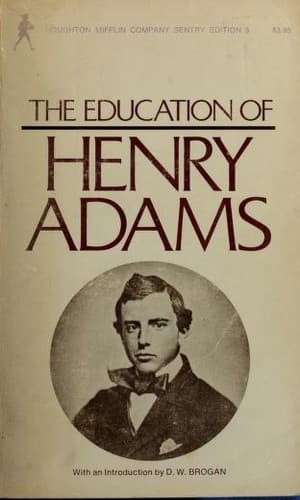
Adams, Henry, 1838-1918; Historians -- United States -- Biography
Society as a rule was civil, and one had no more reason to
complain than every other diplomatist has had, in like conditions, but
one's few friends in society were mere ornament. The Legation could not
dream of contesting social control. The best they could do was to
escape mortification, and by this time their relations were good enough
to save the Minister's family from that annoyance. Now and then, the
fact could not be wholly disguised that some one had refused to
meet--or to receive--the Minister; but never an open insult, or any
expression of which the Minister had to take notice. Diplomacy served
as a buffer in times of irritation, and no diplomat who knew his
business fretted at what every diplomat--and none more commonly than
the English--had to expect; therefore Henry Adams, though not a
diplomat and wholly unprotected, went his way peacefully enough, seeing
clearly that society cared little to make his acquaintance, but seeing
also no reason why society should discover charms in him of which he
was himself unconscious. He went where he was asked; he was always
courteously received; he was, on the whole, better treated than at
Washington; and he held his tongue.
For a thousand reasons, the best diplomatic house in London was
Lord Palmerston's, while Lord John Russell's was one of the worst. Of
neither host could a private secretary expect to know anything. He
might as well have expected to know the Grand Lama. Personally Lord
Palmerston was the last man in London that a cautious private secretary
wanted to know. Other Prime Ministers may perhaps have lived who
inspired among diplomatists as much distrust as Palmerston, and yet
between Palmerston's word and Russell's word, one hesitated to decide,
and gave years of education to deciding, whether either could be
trusted, or how far. The Queen herself in her famous memorandum of
August 12, 1850, gave her opinion of Palmerston in words that differed
little from words used by Lord John Russell, and both the Queen and
Russell said in substance only what Cobden and Bright said in private.
Every diplomatist agreed with them, yet the diplomatic standard of
trust seemed to be other than the parliamentarian. No professional
diplomatists worried about falsehoods. Words were with them forms of
expression which varied with individuals, but falsehood was more or
less necessary to all. The worst liars were the candid. What
diplomatists wanted to know was the motive that lay beyond the
expression. In the case of Palmerston they were unanimous in warning
new colleagues that they might expect to be sacrificed by him to any
momentary personal object. Every new Minister or Ambassador at the
Court of St. James received this preliminary lesson that he must, if
possible, keep out of Palmerston's reach. The rule was not secret or
merely diplomatic. The Queen herself had emphatically expressed the
same opinion officially. If Palmerston had an object to gain, he would
Public-domain text, read in full here on John Shaqi.
Reviews
Reviews
No reviews yet
Be the first to share your thoughts on this work.
Elsewhere in the archive
Join the Discussion
Join the discussion
Sign in to leave a comment or review.
Sign InorCreate an account