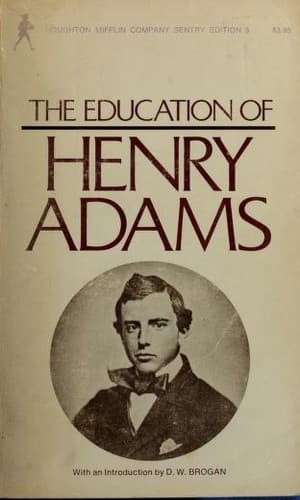
Adams, Henry, 1838-1918; Historians -- United States -- Biography
Late at night when the symposium broke up, Stirling of Keir
wanted to take with him to his chamber a copy of "Queen Rosamund," the
only volume Swinburne had then published, which was on the library
table, and Adams offered to light him down with his solitary bedroom
candle. All the way, Stirling was ejaculating explosions of wonder,
until at length, at the foot of the stairs and at the climax of his
imagination, he paused, and burst out: "He's a cross between the devil
and the Duke of Argyll!"
To appreciate the full merit of this description, a judicious
critic should have known both, and Henry Adams knew only one--at least
in person--but he understood that to a Scotchman the likeness meant
something quite portentous, beyond English experience, supernatural,
and what the French call moyenageux, or mediaeval with a grotesque
turn. That Stirling as well as Milnes should regard Swinburne as a
prodigy greatly comforted Adams, who lost his balance of mind at first
in trying to imagine that Swinburne was a natural product of Oxford, as
muffins and pork-pies of London, at once the cause and effect of
dyspepsia. The idea that one has actually met a real genius dawns
slowly on a Boston mind, but it made entry at last.
Then came the sad reaction, not from Swinburne whose genius
never was in doubt, but from the Boston mind which, in its uttermost
flights, was never moyenageux. One felt the horror of Longfellow and
Emerson, the doubts of Lowell and the humor of Holmes, at the wild
Walpurgis-night of Swinburne's talk. What could a shy young private
secretary do about it? Perhaps, in his good nature, Milnes thought that
Swinburne might find a friend in Stirling or Oliphant, but he could
hardly have fancied Henry Adams rousing in him even an interest. Adams
could no more interest Algernon Swinburne than he could interest
Encke's comet. To Swinburne he could be no more than a worm. The
quality of genius was an education almost ultimate, for one touched
there the limits of the human mind on that side; but one could only
receive; one had nothing to give--nothing even to offer.
Swinburne tested him then and there by one of his favorite
tests--Victor Hugo for to him the test of Victor Hugo was the surest
and quickest of standards. French poetry is at best a severe exercise
for foreigners; it requires extraordinary knowledge of the language and
rare refinement of ear to appreciate even the recitation of French
verse; but unless a poet has both, he lacks something of poetry. Adams
had neither. To the end of his life he never listened to a French
recitation with pleasure, or felt a sense of majesty in French verse;
but he did not care to proclaim his weakness, and he tried to evade
Swinburne's vehement insistence by parading an affection for Alfred de
Musset. Swinburne would have none of it; de Musset was unequal; he did
not sustain himself on the wing.
Public-domain text, read in full here on John Shaqi.
Reviews
Reviews
No reviews yet
Be the first to share your thoughts on this work.
Elsewhere in the archive
Join the Discussion
Join the discussion
Sign in to leave a comment or review.
Sign InorCreate an account