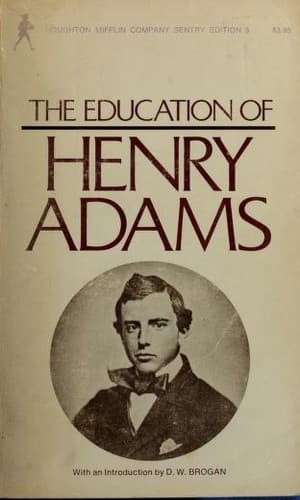
Adams, Henry, 1838-1918; Historians -- United States -- Biography
Adams would have given a world or two, if he owned one, to
sustain himself on the wing like de Musset, or even like Hugo; but his
education as well as his ear was at fault, and he succumbed. Swinburne
tried him again on Walter Savage Landor. In truth the test was the
same, for Swinburne admired in Landor's English the qualities that he
felt in Hugo's French; and Adams's failure was equally gross, for, when
forced to despair, he had to admit that both Hugo and Landor bored him.
Nothing more was needed. One who could feel neither Hugo nor Landor was
lost.
The sentence was just and Adams never appealed from it. He knew
his inferiority in taste as he might know it in smell. Keenly mortified
by the dullness of his senses and instincts, he knew he was no
companion for Swinburne; probably he could be only an annoyance; no
number of centuries could ever educate him to Swinburne's level, even
in technical appreciation; yet he often wondered whether there was
nothing he had to offer that was worth the poet's acceptance. Certainly
such mild homage as the American insect would have been only too happy
to bring, had he known how, was hardly worth the acceptance of any one.
Only in France is the attitude of prayer possible; in England it became
absurd. Even Monckton Milnes, who felt the splendors of Hugo and
Landor, was almost as helpless as an American private secretary in
personal contact with them. Ten years afterwards Adams met him at the
Geneva Conference, fresh from Paris, bubbling with delight at a call he
had made on Hugo: "I was shown into a large room," he said, "with women
and men seated in chairs against the walls, and Hugo at one end
throned. No one spoke. At last Hugo raised his voice solemnly, and
uttered the words: 'Quant a moi, je crois en Dieu!' Silence followed.
Then a woman responded as if in deep meditation: 'Chose sublime! un
Dieu qui croit en Dieu!"'
With the best of will, one could not do this in London; the
actors had not the instinct of the drama; and yet even a private
secretary was not wholly wanting in instinct. As soon as he reached
town he hurried to Pickering's for a copy of "Queen Rosamund," and at
that time, if Swinburne was not joking, Pickering had sold seven
copies. When the "Poems and Ballads" came out, and met their great
success and scandal, he sought one of the first copies from Moxon. If
he had sinned and doubted at all, he wholly repented and did penance
before "Atalanta in Calydon," and would have offered Swinburne a solemn
worship as Milnes's female offered Hugo, if it would have pleased the
poet. Unfortunately it was worthless.
Public-domain text, read in full here on John Shaqi.
Reviews
Reviews
No reviews yet
Be the first to share your thoughts on this work.
Elsewhere in the archive
Join the Discussion
Join the discussion
Sign in to leave a comment or review.
Sign InorCreate an account