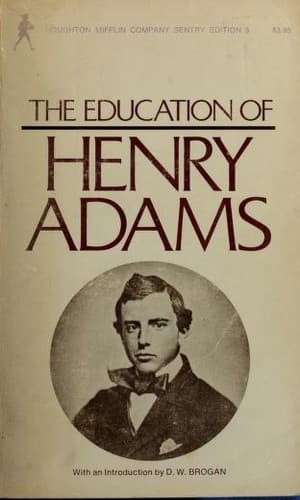
Adams, Henry, 1838-1918; Historians -- United States -- Biography
Such as it was, few young men had more. The spring and summer
of 1863 saw a great change in Secretary Seward's management of foreign
affairs. Under the stimulus of danger, he too got education. He felt,
at last, that his official representatives abroad needed support.
Officially he could give them nothing but despatches, which were of no
great value to any one; and at best the mere weight of an office had
little to do with the public. Governments were made to deal with
Governments, not with private individuals or with the opinions of
foreign society. In order to affect European opinion, the weight of
American opinion had to be brought to bear personally, and had to be
backed by the weight of American interests. Mr. Seward set vigorously
to work and sent over every important American on whom he could lay his
hands. All came to the Legation more or less intimately, and Henry
Adams had a chance to see them all, bankers or bishops, who did their
work quietly and well, though, to the outsider, the work seemed wasted
and the "influential classes" more indurated with prejudice than ever.
The waste was only apparent; the work all told in the end, and
meanwhile it helped education.
Two or three of these gentlemen were sent over to aid the
Minister and to cooperate with him. The most interesting of these was
Thurlow Weed, who came to do what the private secretary himself had
attempted two years before, with boyish ignorance of his own powers.
Mr. Weed took charge of the press, and began, to the amused
astonishment of the secretaries, by making what the Legation had
learned to accept as the invariable mistake of every amateur diplomat;
he wrote letters to the London Times. Mistake or not, Mr. Weed soon got
into his hands the threads of management, and did quietly and smoothly
all that was to be done. With his work the private secretary had no
connection; it was he that interested. Thurlow Weed was a complete
American education in himself. His mind was naturally strong and
beautifully balanced; his temper never seemed ruffled; his manners were
carefully perfect in the style of benevolent simplicity, the tradition
of Benjamin Franklin. He was the model of political management and
patient address; but the trait that excited enthusiasm in a private
secretary was his faculty of irresistibly conquering confidence. Of all
flowers in the garden of education, confidence was becoming the rarest;
but before Mr. Weed went away, young Adams followed him about not only
obediently--for obedience had long since become a blind instinct--but
rather with sympathy and affection, much like a little dog.
Public-domain text, read in full here on John Shaqi.
Reviews
Reviews
No reviews yet
Be the first to share your thoughts on this work.
Elsewhere in the archive
Join the Discussion
Join the discussion
Sign in to leave a comment or review.
Sign InorCreate an account