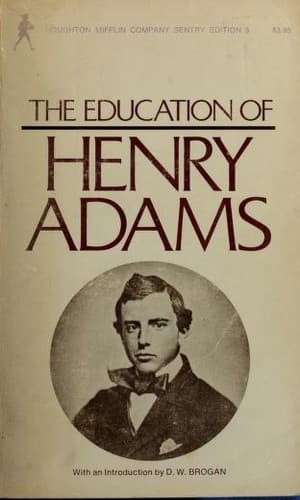
Adams, Henry, 1838-1918; Historians -- United States -- Biography
The three young men returned to London, and each went his own
way. Adams's interest in making friends was something desperate, but
"the London season," Milnes used to say, "is a season for making
acquaintances and losing friends"; there was no intimate life. Of
Swinburne he saw no more till Monckton Milnes summoned his whole array
of Frystonians to support him in presiding at the dinner of the
Authors' Fund, when Adams found himself seated next to Swinburne,
famous then, but no nearer. They never met again. Oliphant he met
oftener; all the world knew and loved him; but he too disappeared in
the way that all the world knows. Stirling of Keir, after one or two
efforts, passed also from Adams's vision into Sir William
Stirling-Maxwell. The only record of his wonderful visit to Fryston may
perhaps exist still in the registers of the St. James's Club, for
immediately afterwards Milnes proposed Henry Adams for membership, and
unless his memory erred, the nomination was seconded by Tricoupi and
endorsed by Laurence Oliphant and Evelyn Ashley. The list was a little
singular for variety, but on the whole it suggested that the private
secretary was getting on.
CHAPTER X
POLITICAL MORALITY (1862)
ON Moran's promotion to be Secretary, Mr. Seward inquired
whether Minister Adams would like the place of Assistant Secretary for
his son. It was the first--and last--office ever offered him, if indeed
he could claim what was offered in fact to his father. To them both,
the change seemed useless. Any young man could make some sort of
Assistant Secretary; only one, just at that moment, could make an
Assistant Son. More than half his duties were domestic; they sometimes
required long absences; they always required independence of the
Government service. His position was abnormal. The British Government
by courtesy allowed the son to go to Court as Attache, though he was
never attached, and after five or six years' toleration, the decision
was declared irregular. In the Legation, as private secretary, he was
liable to do Secretary's work. In society, when official, he was
attached to the Minister; when unofficial, he was a young man without
any position at all. As the years went on, he began to find advantages
in having no position at all except that of young man. Gradually he
aspired to become a gentleman; just a member of society like the rest.
The position was irregular; at that time many positions were irregular;
yet it lent itself to a sort of irregular education that seemed to be
the only sort of education the young man was ever to get.
Public-domain text, read in full here on John Shaqi.
Reviews
Reviews
No reviews yet
Be the first to share your thoughts on this work.
Elsewhere in the archive
Join the Discussion
Join the discussion
Sign in to leave a comment or review.
Sign InorCreate an account